Jul 28, 2026LED Warning Light Bar
How to Specify a Compact 12–24V LED Trailer Rear Lamp: R-413 Buyer Checklist
A practical sourcing checklist for OEMs and distributors specifying compact 12–24V multifunction LED trailer rear lamps, based on the R-413 platform.
How to Specify a Compact 12–24V LED Trailer Rear Lamp: R-413 Buyer Checklist
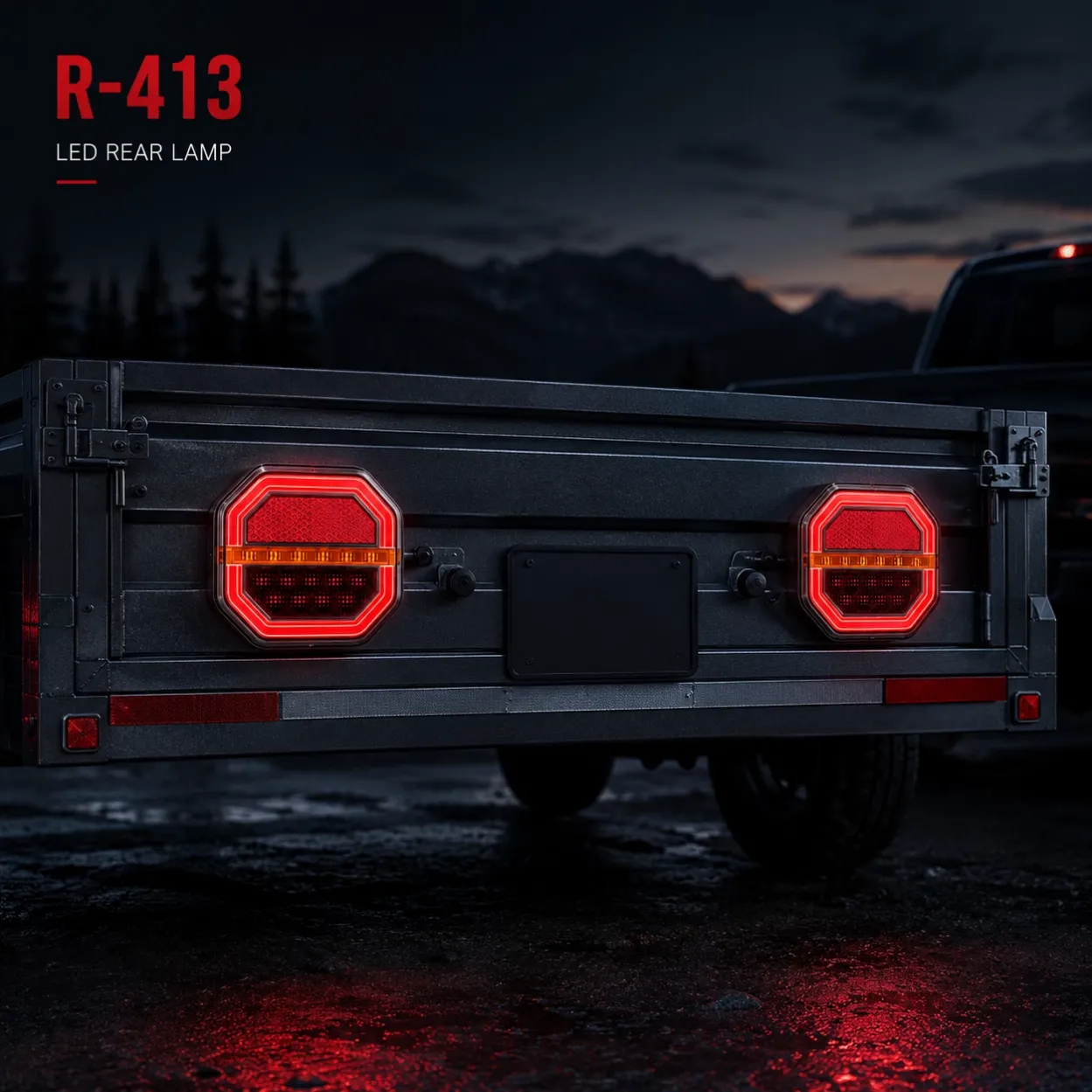
When a trailer OEM, parts importer or private-label lighting brand searches for a compact 12–24V LED trailer rear lamp, the first question is rarely “How many LEDs are inside?” The practical question is whether the lamp can fit the rear panel, connect correctly, deliver the required functions and be supported with consistent documentation over repeat orders. The R-413 is a useful example because its brochure lists tail, stop/brake, indicator and license-plate functions in one compact housing.
Start with the application, not the catalog image
A combined rear lamp can reduce the number of individual light positions and wiring interfaces on a trailer. That can simplify rear-panel assembly for a trailer manufacturer and reduce SKU fragmentation for a distributor. But this benefit only exists when the lamp’s position, function separation and wiring match the vehicle design. Before asking for a quotation, define whether the lamp is for a utility trailer, cargo trailer, equipment trailer, light commercial body or replacement program, and identify the destination market.
Check the physical envelope before discussing price
The R-413 brochure lists a 117 × 107 × 43 mm body and screw mounting. These are commercial details, not just engineering details: a mismatch in the mounting footprint can cause rework, delayed production and avoidable returns. Ask for the mounting-hole pattern, fastener recommendation, rear clearance, cable exit direction and a dimensional drawing. A production-intent sample should be fitted to the actual rear panel before a container order is released.
Why 12–24V matters to B2B buyers
The brochure specifies 12–24V operation. For importers serving both light-trailer and commercial-vehicle customers, one voltage platform can reduce duplicate inventory and simplify forecast planning. Voltage range alone is not sufficient for a purchasing decision. Request current draw for each function, polarity, wire-color or pinout diagram, connector option, cable length and any electrical protection details needed for the vehicle. These checks reduce installation disputes and warranty claims caused by wiring mistakes.
Treat multifunction claims as a wiring-validation task
The R-413 brochure lists tail, stop/brake, direction indicator and license-plate illumination. Combining four functions may reduce component count, but it creates a need for clear function-level validation. Buyers should energize each circuit on the final sample, verify brightness and function separation, and record the wiring configuration in the approved sample file. A clear pinout supports production teams, service technicians and distributor customers long after the first delivery.
Materials and environmental figures need evidence
The brochure lists ABS, PC and PMMA construction, an operating temperature of -42°C to +67°C and a 65,000-hour lifetime figure. These values can help a buyer form an initial technical comparison, but they should not automatically be copied into a warranty promise or tender document. Request model-specific test information and confirm which conditions were used. This protects the buyer from making a field-performance claim that the supplied documentation cannot support.
Do not assume an IP rating or road approval
The R-413 brochure does not state an IP rating, CE marking or ECE approval. That absence matters. A procurement manager should not fill the gap with assumptions based on similar-looking lamps. If the target market requires an ingress-protection level or road-use approval, request documents that name the exact model and relevant function, then compare them with lens markings and the supplied sample. This simple discipline reduces compliance risk for brands and importers.
Clarify ambiguous LED wording before publishing a specification
The brochure uses the phrase “48 LED / 36 PCS.” It is not safe to turn this wording into a wattage or luminous-output claim without clarification. Ask for an approved bill of materials, function-level power data and sample inspection record. Accurate specifications make listings more useful to fleet and distributor customers and reduce the risk of later correction.
A practical RFQ and pilot-order checklist
A strong RFQ for a compact LED trailer rear lamp should include trailer type, destination market, expected annual quantity, mounting drawing, connector or wire requirement, required functions, packaging request, label artwork and compliance requirements. Before volume purchase, approve a golden sample with the finished wiring, lens color, packaging and markings. The R-413 can be evaluated as a compact multifunction platform, but the final purchasing decision should rest on fitment, documented requirements and validated samples—not a generic feature list.
For OEM, distributor and private-label programs, this approach turns a product search into a controlled sourcing decision: fewer assumptions, cleaner installation planning and a more defensible after-sales process.
