Jul 28, 2026LED Warning Light Bar
What Do ECE R10, R148 and R150 Mean When Sourcing LED Trailer Rear Lamps?
A B2B buyer guide to checking brochure-listed ECE R10, R148 and R150 claims when sourcing IP67 multifunction LED trailer rear lamps such as R-414.
What Do ECE R10, R148 and R150 Mean When Sourcing LED Trailer Rear Lamps?
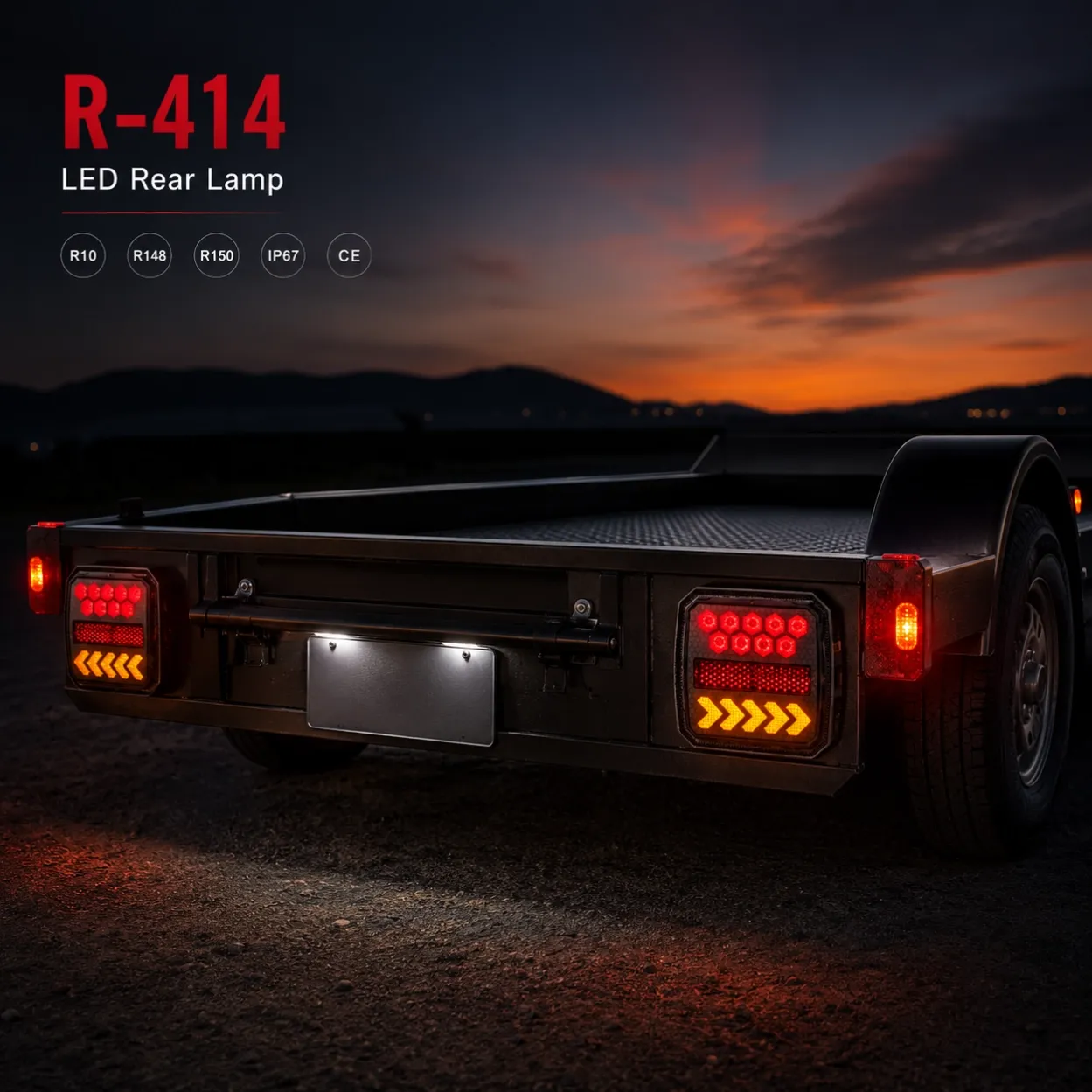
For an OEM buyer or trailer-parts importer, an approval code in a brochure is a starting point for due diligence—not the end of it. The R-414 LED trailer rear lamp brochure lists CE, ECE R10, R148 and R150, together with IP67 protection and tail, stop/brake, indicator and license-plate functions. These details can make the product relevant to regulated trailer-lighting projects, but each claim must be tied to the exact model, function and supplied configuration before it is used in sales material or a vehicle program.
Why approval references affect purchasing risk
Compliance documents influence market access, customer confidence and the cost of a product recall or rejected shipment. A brand owner may need proof before adding a lamp to its catalog. A trailer manufacturer may need it before signing off a rear-light installation. A distributor may need it to answer a professional customer’s technical question accurately. The business value of an approval is therefore traceability: it helps the buyer verify what has been tested and what is actually being purchased.
Use the R-414 brochure as a verification case
The R-414 is presented as a paired LED rear lamp platform with tail, stop/brake, indicator and license-plate functions. Its listed body size is 110 × 103 × 43 mm; the brochure also lists screw mounting, wire or connector connection, ABS + PC + PMMA materials, 12–24V operation and IP67. These figures support an initial fitment and environmental review. They do not replace a drawing, a wiring diagram or model-specific approval files.
What to request before marketing an ECE-listed lamp
Ask for the approval documents that identify the exact R-414 model or part number, the applicable function, the tested lens/variant and the issuing authority. Check whether the lens marking on the sample corresponds with the documentation. Confirm whether the quotation covers the same left/right arrangement, wire or connector version and color configuration that was approved. Keep these records with the golden sample. This is particularly important when a buyer plans private-label packaging or multiple connector options.
EMC, signal and reflector requirements should not be blended together
A buyer will often see several ECE references in one catalog line. The practical task is to understand which document applies to which aspect of the lamp and vehicle installation. Do not simply write “ECE approved” on a product page without the supporting scope. Instead, retain the precise reference, attach the relevant document to the internal sourcing file and confirm that the planned application is covered. When regulations or a vehicle homologation program are involved, use qualified local compliance advice.
IP67 is useful when it is connected to the installation environment
The R-414 brochure lists IP67. For trailers exposed to rain, road spray and regular washing, ingress protection is a meaningful purchasing criterion because water-related failures can create service costs and damage a distributor’s reputation. The correct procurement step is to ask for the relevant IP test evidence and verify the assembled version: housing, lens, cable exit and connector all affect the final product. IP67 should not be treated as a substitute for correct sealing, mounting and cable routing on the vehicle.
Paired lamps reduce fitment ambiguity only when left and right are controlled
The R-414 presentation includes a left/right pair. Pairing can help trailer builders maintain a consistent rear appearance and make a replacement program easier to organize. It also creates a simple quality-control requirement: confirm left and right part numbers, indicator direction, lens markings and pack identification before production. A photograph alone does not protect against a mixed shipment; an approved sample and carton label do.
Power and LED claims need the same discipline
The brochure lists “1W × 48 LEDs,” license-plate power of 2W and stop/brake power of 5W, alongside “48 LED / 36 PCS” wording. Because these values may refer to different configurations or functions, buyers should request the approved bill of materials and function-level electrical data rather than calculate a total figure for sales use. This avoids inaccurate luminous-output claims and keeps catalog information aligned with the delivered product.
A sourcing checklist for trailer-lighting teams
Before a volume order, validate the dimensional drawing, mounting-hole pattern, 12V and 24V current draw, wiring/pinout, left/right configuration, connector choice, IP67 evidence, CE and ECE documents, lens markings, operating-temperature evidence, packaging, label artwork and traceability process. Run a pilot order using the final connector and packaging. If a customer asks about approval status, answer from the controlled document set rather than a generalized catalog statement.
The R-414 can be a practical candidate for buyers seeking a compact, IP67, multifunction trailer rear lamp with brochure-listed CE and ECE references. The commercial advantage comes from disciplined verification: the right evidence, the right variant, the right sample and clear records for every later shipment.
