Jul 10, 2026LED Warning Light Bar
How to Source a Reliable 48W LED Strobe Beacon for Work Vehicles
A practical B2B guide to evaluating 48W amber LED strobe beacons, comparing DIN and magnetic mounts, flash patterns, durability, installation, compliance and supplier risk.
How to Source a Reliable 48W LED Strobe Beacon for Work Vehicles
For an importer, distributor, equipment manufacturer or fleet buyer, an amber LED beacon is not a decorative accessory. It is a safety component that affects vehicle visibility, installation time, warranty exposure and customer confidence.
That is why choosing an LED strobe beacon supplier should involve more than comparing wattage and unit price. A lower quotation can become expensive when installers receive the wrong mounting type, flash patterns are inconsistent between batches, housings fail in demanding environments, or compliance documents do not match the delivered product.
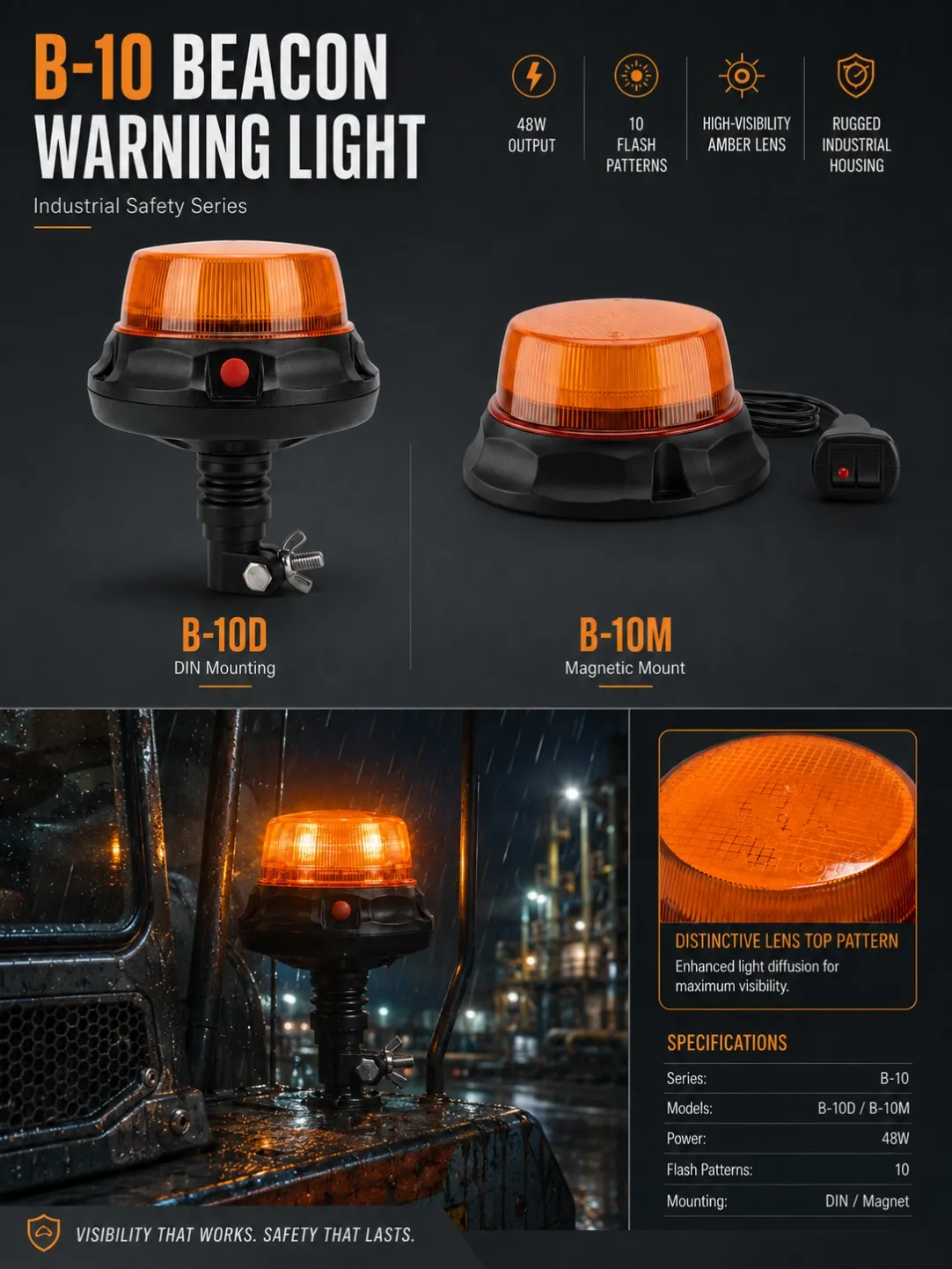
This guide uses the B-10 warning beacon as a practical example. It focuses only on features stated in the product information: 48W output, 10 flash patterns, a high-visibility amber lens, a distinctive lens-top pattern, rugged industrial housing, and two mounting options—B-10D DIN mount and B-10M magnetic mount.
WHO IS MOST LIKELY TO BUY THIS TYPE OF LED STROBE BEACON?
Importers and automotive lighting distributors
Importers need a warning light that can serve several commercial vehicle segments without creating unnecessary inventory complexity. A beacon family with DIN and magnetic versions allows a distributor to address permanent and temporary installation needs while keeping the product platform consistent. The commercial value is a broader sales range with fewer unrelated products to manage.
Private-label brand owners
Brand owners are concerned about repeatable appearance, specification consistency, packaging accuracy and warranty rates. The B-10 platform gives them a defined series with two clearly separated model codes. This matters because clear model control reduces order mistakes and helps sales teams explain mounting differences to dealers. Any private-label, packaging or branding program should still be confirmed in writing before purchase.
Equipment manufacturers and vehicle body builders
OEM and body-building customers need a mounting method that fits the vehicle design and assembly process. A DIN mount can suit vehicles already designed around a beacon pole or socket, while a magnetic version can support applications where temporary placement is more practical. Selecting the correct version early can reduce rework on the assembly line and prevent installers from improvising unsuitable mounting solutions.
Construction and agricultural machinery suppliers
Machines working around personnel, loading areas and low-speed traffic need a clear warning signal. Suppliers in these sectors also face demanding duty cycles and service conditions. A rugged housing and visible amber lens matter because product failures create dealer complaints, technician visits and replacement costs. The purchasing value is not simply “durability”; it is lower service disruption when the product is matched to the application and installed correctly.
Fleet equipment and service-vehicle companies
Utility fleets, maintenance contractors, roadside service operators and municipal vehicle suppliers often need warning lights across mixed vehicle types. Ten selectable flash patterns and two mounting approaches can help standardize a beacon family while still accommodating different operating policies. This can simplify technician training and spare-parts planning.
THE REAL PURCHASING PROBLEMS BEHIND A WARNING BEACON
High warranty and replacement costs
The cost of a failed beacon is rarely limited to the replacement unit. A fleet may need to remove a vehicle from service, schedule a technician and process a warranty claim. A distributor may also pay freight twice and lose customer confidence. This is why buyers should evaluate housing construction, lens security, batch consistency and supplier quality controls—not only brightness claims.
Installation mismatch
A technically acceptable light can still become the wrong product if the mounting method does not fit the vehicle. The B-10D DIN version is intended for DIN mounting, while the B-10M is the magnetic mount model. Keeping these variants clearly separated helps purchasing teams specify the correct item before production or shipment. That reduces installation delays, returned goods and last-minute modifications.
Inconsistent visibility across operating conditions
A beacon must communicate a warning signal clearly, not merely produce light. The amber lens and distinctive top pattern are designed to improve light diffusion and visibility. For a B2B buyer, the value is more consistent visual recognition around work vehicles, which supports safer operating procedures and improves end-customer satisfaction.
Too many SKUs for similar applications
Distributors frequently carry several unrelated beacons because each customer asks for a different mounting style or flash behavior. Ten selectable flash patterns can cover different operating preferences within one product platform. Combined with DIN and magnetic variants, this may reduce the need to source a separate model for every basic use case. Buyers should still confirm the required flash mode during sample approval.
Unclear certification and compliance claims
Regulations for warning lights vary by country, vehicle category and application. The brochure does not state any specific certification, so a responsible buyer should not assume regulatory approval. Ask for the exact certificates, test reports and model references required for your market before placing a production order.
Environmental protection claims also need verification. For this product range, any ingress-protection claim should not exceed IP67 and should be supported by the documents supplied for the ordered model. A brochure image or a general statement is not a substitute for a matching test report.
HOW THE CONFIRMED B-10 FEATURES CREATE BUSINESS VALUE
48W output: evaluate visibility and system fit together
The B-10 is rated at 48W. Output matters because the beacon must remain noticeable around active work areas and industrial vehicles. For buyers, however, the specification also affects electrical planning. Before approval, confirm the operating voltage, connector or wiring arrangement, current draw and compatibility with the target vehicle. These details are not stated in the brochure and should be documented during sampling.
The business value of this review is fewer installation surprises and less risk of approving a light that cannot be integrated cleanly into the vehicle electrical system.
Ten flash patterns: flexibility without multiplying inventory
Ten selectable flash patterns give dealers, fleets and equipment builders options for different warning preferences. This can help an importer serve more customers with one beacon platform rather than purchasing many low-volume variants.
The purchasing benefit is lower SKU complexity and potentially more efficient inventory planning. During sample evaluation, check how patterns are selected, whether the setting is retained after power cycling, and whether every production batch follows the same pattern sequence.
High-visibility amber lens: clear warning identification
Amber is widely used for non-emergency work vehicles, construction equipment, maintenance fleets and machinery operating near personnel. The B-10 uses a high-visibility amber lens. The practical value is immediate warning recognition without relying on decorative styling.
For distributors, consistent lens color and appearance also matter for repeat orders. Approve a physical color sample and retain a reference unit when batch-to-batch appearance is commercially important.
Distinctive lens-top pattern: light diffusion with a practical purpose
The lens-top pattern is intended to enhance light diffusion. This feature matters when the beacon is viewed from different positions around a vehicle. The business benefit is a more useful warning signal rather than concentrated brightness visible from only a limited angle.
Buyers should assess the sample at realistic mounting height and from several viewing positions. A controlled demonstration is more valuable than relying on camera exposure in a promotional video.
Rugged industrial housing: focus on service risk
The B-10 is described as having a rugged industrial housing. This is relevant for construction, agricultural, utility and service-vehicle environments where vibration, impact exposure, dust and weather can affect service life.
For purchasing managers, the important outcome is reduced failure risk and fewer field replacements. Because the brochure does not provide vibration, impact, temperature or material test data, request those details when they are essential to the application. A careful supplier should distinguish between confirmed test results and general product positioning.
DIN and magnetic mounts: choose according to the operating model
The B-10D DIN mount is the better starting point when a vehicle has a compatible beacon socket and requires a repeatable installed position. It can suit equipment manufacturers, body builders and fleets that want standardized installation.
The B-10M magnetic version is intended for flexible placement. It may suit temporary service vehicles, equipment that cannot be permanently modified, demonstration fleets or users who transfer the warning light between vehicles. The product image shows a power cable and switch with the magnetic model.
The business value of offering both versions is reduced installation friction. The correct choice depends on vehicle design, expected speed, surface material, cable routing and the customer’s operating procedure. Magnetic mounting should never be treated as universally suitable; buyers should validate holding force and placement for the intended use.
TYPICAL APPLICATIONS
Based on the available product information, the B-10 can be considered for:
• Construction vehicles working near personnel or traffic
• Utility and maintenance fleets
• Agricultural machinery
• Service trucks and roadside-support vehicles
• Material-handling and industrial equipment
• Other work vehicles requiring an amber warning signal
Application suitability should be confirmed against local regulations, vehicle speed, mounting position, electrical system and environmental requirements.
A PRACTICAL SAMPLE-APPROVAL CHECKLIST FOR B2B BUYERS
Before confirming a wholesale or OEM vehicle warning light order, evaluate the following points:
- Confirm the exact model: B-10D DIN mount or B-10M magnetic mount.
- Verify 48W rating and obtain the operating-voltage specification.
- Test all 10 flash patterns and document the selection method.
- Check visibility from the front, rear, sides and elevated viewing angles.
- Inspect the amber lens, lens-top pattern and housing assembly.
- Confirm cable, switch, connector and installation accessories for the selected version.
- Request model-specific compliance documents required in the destination market.
- Ensure any ingress-protection claim is supported and does not exceed IP67.
- Approve packaging, labels, manuals and carton markings before mass production.
- Define acceptable quality limits, warranty handling and replacement procedures.
- Confirm lead time, order quantity, spare-part policy and batch traceability.
- Keep a signed reference sample for comparison with production shipments.
This process reduces purchasing risk because technical approval, packaging approval and commercial terms are aligned before volume production.
QUESTIONS TO ASK AN LED STROBE BEACON MANUFACTURER
A serious sourcing discussion should include practical questions:
• Which specifications are verified by current test reports?
• Which certificates apply to the exact model, not only the product family?
• How are flash-pattern consistency and lens appearance controlled between batches?
• What inspection records are available before shipment?
• What is included with each mounting version?
• Can packaging and labeling requirements be documented before production?
• How are warranty claims analyzed and resolved?
• What changes require buyer approval after the sample is signed?
These questions help distinguish a usable supply program from a product that only looks suitable in a brochure.
CHOOSING BETWEEN PRICE AND TOTAL PURCHASING COST
The lowest unit price is not always the lowest commercial cost. Importers and fleet suppliers should include inspection, rework, installation time, rejected units, replacement freight and warranty administration in the decision.
A 48W amber LED strobe beacon with clearly defined mounting versions and flash options can reduce complexity, but only when the supplier documents the specification and production matches the approved sample. The buyer’s objective should be predictable performance and manageable after-sales risk, not an exaggerated list of features.
FINAL PURCHASING PERSPECTIVE
The B-10 offers a straightforward set of confirmed features: 48W output, 10 flash patterns, an amber high-visibility lens, a diffusion-focused top pattern, rugged industrial housing, and DIN or magnetic mounting.
For an importer, distributor, brand owner or equipment manufacturer, the strongest value comes from matching these features to a real operating requirement. DIN mounting can support standardized installation. Magnetic mounting can provide flexibility. Multiple flash patterns can reduce product fragmentation. A rugged housing can support lower service risk when relevant test evidence is available.
Before requesting a quotation, prepare the target market, vehicle type, mounting choice, estimated quantity, required documentation and packaging expectations. Sharing those details allows a supplier to confirm whether the product is a practical fit and helps both sides avoid preventable changes after sampling.
