Jul 22, 2026LED Warning Light Bar
How to Source Magnetic Rechargeable Warning Lights for Commercial Fleets
A practical sourcing checklist for portable magnetic LED warning lights used by trucks, trailers and roadside service fleets.
How to Source Magnetic Rechargeable Warning Lights for Commercial Fleets
Portable warning lights are attractive to fleets because they can be deployed quickly without permanent wiring. They also create purchasing risks that fixed lamps do not: battery condition, charging discipline, magnetic holding force and lost accessories all affect field performance.
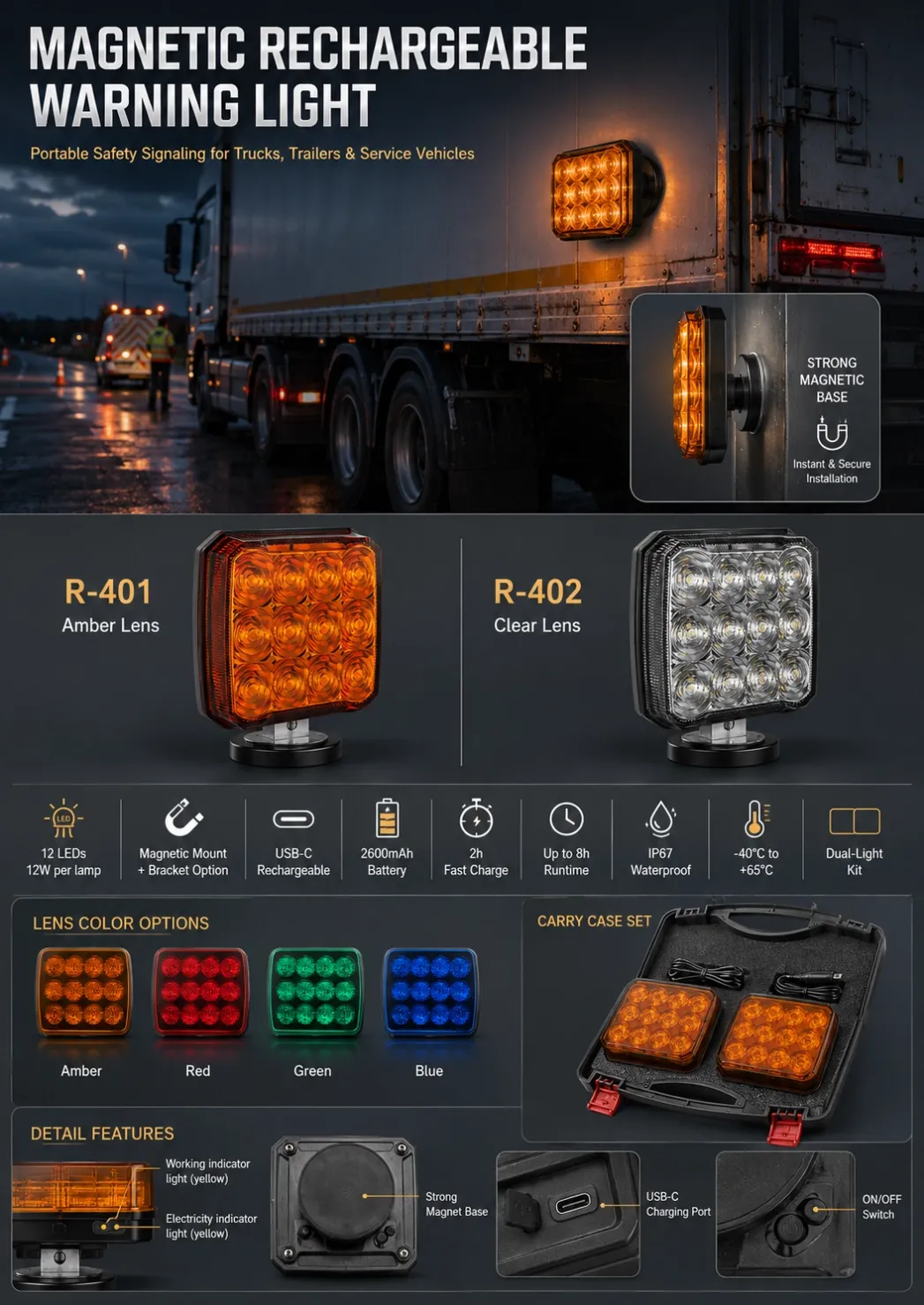
The R-401/R-402 dual-light kit provides a useful framework for evaluating this category.
Decide Where Portable Lights Add Value
Magnetic rechargeable warning lights are best suited to temporary or mobile tasks. Typical users include roadside assistance teams, maintenance vehicles, trailers, rental fleets and service trucks.
The main commercial benefit is fast deployment. A strong magnetic base allows the lamp to be positioned without drilling the vehicle body. This reduces installation labor and avoids permanent changes to leased or multi-purpose vehicles.
A bracket option is also shown. Buyers should decide whether the product will remain portable or be assigned to a semi-permanent position, because that affects the mounting hardware and packaging required.
Evaluate the Battery Against Real Shift Use
Each lamp uses a 2600mAh battery. The brochure specifies two-hour fast charging and up to eight hours of operating time.
“Up to” runtime should be treated as a planning figure, not a guarantee for every mode and temperature. Procurement teams should test the actual flash pattern and operating conditions used by the fleet. A winter roadside team may experience different performance from a warehouse or warm-weather application.
Charging time also matters operationally. If a vehicle returns for only a short interval between shifts, the fleet may need extra kits or a charging rotation. USB-C charging can simplify accessory sourcing, but buyers should confirm the included cable and power-adapter specification.
Check the Lens and Signal Configuration
R-401 uses an amber lens, while R-402 uses a clear lens. Both models use 12 LEDs and are rated at 12W per lamp. The brochure also shows amber, red, green and blue lens-color options.
Color selection is a regulatory decision. Buyers should confirm which color and flash mode are permitted for the intended vehicle class and market. A color that is acceptable for private-site use may not be legal on public roads.
Magnetic Holding Force Is an Installation Requirement
A magnetic base saves installation time only if the vehicle surface is suitable. Aluminum, composite or heavily curved panels may not provide a secure mounting area. Dirt between the magnet and body can also reduce grip or damage paint.
Sample evaluation should include the actual panel material, vehicle speed, vibration and weather exposure. Operators need a simple instruction for cleaning the mounting surface and checking attachment before use.
Why the Carry Case Matters
The R-401/R-402 set is supplied as a dual-light kit with a carry case. For a fleet, the case is more than packaging. It keeps the two lamps and charging accessories together, makes vehicle-level inventory easier and reduces the chance that equipment is lost between jobs.
Importers should confirm the case layout, accessory list and replacement-part policy. A missing cable or damaged case can make an otherwise functional lamp unavailable.
Environmental Protection
The lamps are rated to IP67 and specified from -40°C to +65°C. Portable lights are often placed in exposed locations during rain, dust or snow, so environmental protection directly affects reliability.
Even with IP67, buyers should verify that the USB-C port cover is secured correctly and include this point in operator instructions. Misuse of a charging-port cover can create avoidable water-ingress claims.
Controls and Status Information
The product includes an on/off switch, a working indicator and an electricity indicator. Visible status information helps operators identify whether a lamp is active and when charging is required.
This reduces a common fleet problem: discovering an uncharged safety device only after arriving at the work site.
Commercial and Compliance Checks
The brochure does not list a certification. Before regulated road use, the buyer should request the required test reports or approvals and confirm local rules. Do not assume that IP67 or a colored lens is equivalent to traffic approval.
A complete RFQ should state the model, lens color, flash requirement, quantity per case, charging accessories, bracket requirement, packaging, logo needs and destination-market documents. Testing should cover runtime, charging, magnetic retention, weather exposure and accessory control.
A portable warning-light program succeeds when the equipment is charged, complete and easy to deploy. Those operational details matter as much as the lamp output itself.
