Jul 21, 2026LED Warning Light Bar
How to Evaluate a 7-Function LED Trailer Tail Light for Commercial Use: The T03A Buyer’s Guide
The T03A combines seven rear-lighting functions with a 10–30V input, IP67 protection, a 5 m wiring set and 13-pin plug. This practical guide explains what importers, trailer builders and distributors
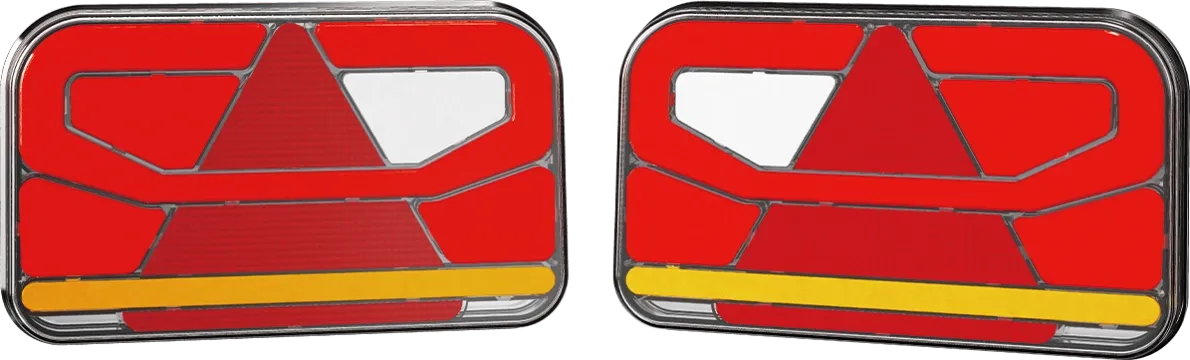
Choosing a rear lamp for a commercial trailer is rarely just a question of appearance or brightness. For an importer, trailer builder or replacement-parts distributor, the more important questions are whether the lamp covers the required functions, fits the electrical system, installs consistently, arrives with the right compliance documentation and can be supported as a repeatable product line.
The T03A is a rectangular LED rear combination lamp intended for trucks and trailers. It operates on 10–30V and combines tail/position, stop, direction indicator, reverse, rear fog, number-plate illumination and a rear retro-reflector in a left- and right-hand pair. The lamp measures 230 × 140 × 32 mm, is rated IP67 and is supplied as a plug-and-play wiring solution with a 5 m cable and 13-pin plug. The brochure also lists ECE R10, ECE R148, ECE R150 and CE.
Those specifications are useful, but they only matter when they solve a purchasing or operating problem. The following sections translate the technical details into the questions a B2B buyer should ask before approving the lamp for a range, a trailer platform or a replacement program.
Which buyers are most likely to use the T03A?
Trailer manufacturers and commercial vehicle bodybuilders
Manufacturers need a rear-lighting package that can be repeated across production without creating avoidable wiring work at every station. A matched left/right lamp set, a 5 m cable and a 13-pin plug can reduce the number of separate components that production teams must source and connect. The 10–30V input also gives engineering teams one voltage range to evaluate for common 12V and 24V vehicle platforms.
This does not remove the need for a fitment check. Builders should still confirm mounting-hole positions, cable routing, connector pinout and the function assignment on the target vehicle before releasing the lamp to production.
Importers and regional automotive-lighting distributors
Importers are usually balancing three risks: local compliance, after-sales claims and inventory complexity. The T03A brings several rear functions into one housing and one paired wiring system. That can be easier to catalogue than stocking separate stop, tail, indicator, reverse, fog and number-plate lamps for the same application.
The commercial value is not simply “more functions.” It is the possibility of a clearer SKU, a more complete kit and fewer missing-component complaints from dealers. Before ordering, the importer should request the applicable approval documents and verify that their markings and scope match the destination market and the exact product supplied.
Trailer-parts wholesalers and service networks
Repair workshops want replacement products that technicians can identify, fit and test without lengthy rewiring. The direct rear mounting, defined 230 × 140 × 32 mm envelope and plug-and-play connection are relevant because workshop labor often costs more than the difference between two lamp quotations.
A wholesaler should therefore evaluate the total installation package, not just the lamp body. Check whether every production batch includes the same cable length, connector, left/right configuration, mounting hardware and wiring information.
Fleet maintenance and trailer rental operators
Fleet operators do not normally buy on the basis of brochure language. They consider downtime, repeat failures and the ability to hold the right replacement stock. IP67 ingress protection is meaningful because rear lamps work close to road spray and are regularly exposed to dust and wet conditions. For a fleet, the business benefit is reduced exposure to moisture-related service events—not a promise that a lamp can survive every cleaning method or operating condition.
The IP67 rating should therefore be treated as a defined protection level. Buyers should not assume a higher rating, and installation teams should protect connectors and cable routing according to the supplied instructions.
Seven functions in one housing: what does that change for procurement?
The T03A integrates the following functions:
- Tail/position light
- Stop/brake light
- Rear direction indicator
- Reverse light
- Rear fog light
- Number-plate light
- Rear retro-reflector
For a purchasing manager, integration can reduce the number of separate lamp bodies, brackets, cables and purchasing lines needed at the rear of a trailer. It may also simplify packaging for a replacement kit and make the finished installation look more consistent.
However, integrated products also concentrate responsibility in one component. If a buyer is considering the T03A for a fleet or OEM program, the sample validation should test every function on both the left- and right-hand units. The buyer should also define how warranty replacements will be handled: as individual lamps, as a pair or as a complete cable-and-lamp kit.
That policy matters because unclear replacement rules create avoidable distributor costs and customer dissatisfaction even when the original product specification is correct.
Why the 10–30V operating range matters
Commercial vehicle product ranges often include both nominal 12V and 24V systems. A 10–30V lamp gives buyers a single stated input range to assess across those platforms. For importers, this may reduce the need to hold separate voltage-specific SKUs. For trailer manufacturers, it can simplify component standardization across several models.
The purchasing benefit is lower inventory fragmentation and a smaller risk of sending the wrong voltage variant to a customer. The engineering team should still verify the full vehicle electrical architecture, connector pinout and any monitoring or load-detection requirements. The brochure confirms the operating range but does not claim compatibility with every vehicle electronics system.
Installation time is a purchasing cost
The T03A is designed for direct rear mounting and is supplied with a 5 m cable and 13-pin plug. In practical terms, a preconfigured connection can reduce cable preparation, terminal assembly and wiring mistakes compared with a lamp supplied only with short bare leads.
This matters in three different ways:
- A trailer builder can reduce assembly steps and make installation time more predictable.
- A workshop can complete replacement work with less wiring modification, provided the existing connection matches.
- A distributor can offer a more complete package rather than asking the buyer to source a separate harness.
Before a bulk order, test the cable length on the longest intended routing path. Confirm strain relief, connector location and left/right cable routing on a real trailer. A 5 m cable is only an advantage if it reaches the connection point without unsafe tension, excessive coiling or exposure to moving components.
IP67 protection: useful, but it should be stated accurately
The stated ingress-protection level is IP67. For buyers working with commercial vehicles, this addresses a real concern: dust and water ingress can lead to intermittent operation, corrosion-related faults, warranty claims and vehicle downtime.
IP67 gives procurement teams a clear qualification point when comparing lamps. It should not be described as IP68, IP69K or “completely waterproof,” because those claims are not supported by the T03A brochure. It also does not replace good installation practice. Cable entry, connector sealing and mounting orientation remain part of the finished system.
For incoming quality control, buyers may wish to define visual checks for seals, lenses, cable exits and connector condition. Consistent inspection criteria are more useful than a broad promise of durability.
What the listed certifications mean for a sourcing decision
The brochure lists ECE R10, ECE R148, ECE R150 and CE. This is commercially relevant for importers, distributors and vehicle manufacturers that need documented products for regulated markets.
The practical value is reduced compliance uncertainty during product evaluation. It gives the buyer a defined set of documents to request and compare against the exact model, lamp markings and intended market. It can also make internal approval faster when engineering, compliance and purchasing teams are working from the same document set.
Responsible buyers should not rely on a logo alone. Before placing a production order, request copies of the applicable certificates or test reports, confirm the model reference and verify that approval markings on the sample correspond to the documents. Local vehicle rules and installation requirements still need to be checked by the buyer.
Dimensions and mounting: prevent fitment returns before they happen
At 230 × 140 × 32 mm, the T03A has a low-profile rectangular format. Defined dimensions help bodybuilders plan the rear panel and help distributors answer fitment questions with measurable information rather than guesswork.
For an importer, accurate dimensional data reduces the chance of returns caused by a lamp that does not fit the customer’s bracket or rear panel. For an OEM buyer, it supports drawing review and prototype installation before tooling or production scheduling begins.
The correct approval process should include a physical sample. Check clearance around the lamp, the position of mounting points, the rear cable and connector, visibility angles and the number-plate illumination area. Do not approve a lamp solely because the overall width and height look similar to an existing unit.
T03A or T04B: why two versions can help a product range
The brochure presents two related versions, T03A and T04B, with the same overall size, input range, IP67 rating and wiring concept but different lens layouts. The T03A’s product diagram specifically identifies a number-plate-light function, making it suitable for buyers who want that function integrated into the rear-lamp package.
For distributors, two visually distinct versions can serve different customer preferences while keeping several core specifications aligned. For trailer builders, the choice should be based on the required lamp functions, rear-panel design and market requirements—not on styling alone.
A practical sample-approval checklist
Before committing to a bulk order, a B2B buyer should verify:
- The exact T03A model and left/right configuration
- All seven functions on both lamps
- 10–30V operation on the intended vehicle platform
- 230 × 140 × 32 mm fit and mounting arrangement
- 5 m cable routing and the 13-pin connector pinout
- IP67 documentation and physical sealing quality
- ECE R10, R148, R150 and CE documents for the supplied model
- Lamp approval markings and their match to the paperwork
- Packaging protection for lenses, cables and connectors
- Batch identification, inspection criteria and warranty procedure
- Spare-part policy for individual lamps, pairs and wiring sets
This checklist connects technical approval with the commercial questions that often cause problems later: incomplete kits, unclear fitment, inconsistent batches and difficult warranty handling.
Questions to include in an RFQ
A useful request for quotation should ask more than price and minimum order quantity. Include the required annual volume, destination market, target vehicle type and expected packaging. Ask the supplier to confirm the exact functions, left/right part references, included cable and connector, approval documents, production lead time, sample lead time, carton details and warranty process.
If private labeling or customized packaging is needed, request it as a separate, documented requirement. The brochure does not state those services, so availability should be confirmed rather than assumed.
Final purchasing perspective
The T03A is most relevant to buyers looking for a compact, multi-function LED trailer tail light with an integrated number-plate-light function and a ready-to-connect wiring package. Its 10–30V range can support SKU standardization, the 5 m cable and 13-pin plug can reduce installation work, IP67 addresses a defined level of ingress protection, and the listed ECE/CE certifications provide a starting point for compliance review.
The strongest sourcing decision will come from matching those features to a real vehicle, verifying the documents and agreeing on packaging, quality control and replacement procedures before volume production. Buyers evaluating the T03A for distribution, OEM use or fleet replacement can request a sample and technical document set for a structured fitment and compliance review.
