Aug 14, 2026 LED Truck Driving Light
How to Specify a 10–48V LED Light Bar: 819A B2B Buyer Guide
A practical B2B guide to LED light bar length, output, thermal design, voltage, approval documents and sample tests for truck and heavy-equipment programs.
How to Specify a 10–48V LED Light Bar: 819A B2B Buyer Guide
A buyer comparing LED light bars rarely has a shortage of wattage and lumen claims. The difficult part is deciding which claims can be translated into a reliable product program. A light bar that looks competitive on a quotation can still create fitment complaints, unstable field performance, excess inventory or delayed market approval.
This guide uses the HydroSolaris 819A air-duct cooling LED light bar as a practical specification example. It is written for importers, distributors, vehicle-lighting brands, OEM engineers, equipment dealers and fleet upfitters. The purpose is not to declare one lamp “best.” It is to show what procurement teams should verify before approving samples and committing to volume.
What should a B2B buyer check before buying a 10–48V LED light bar?
Start with six questions: Which vehicles will use it? Which physical length fits each installation? What beam and usable illumination are required? What current will the selected model draw at the target voltage? Which approval documents apply to the exact model and function? How will production consistency be checked after the golden sample is approved?
These questions connect technical features to commercial risk. They help prevent the common situation in which a purchasing team approves a sample based on appearance, then discovers during installation that brackets, wiring, heat, documentation or product range planning were not resolved.
Pain point 1: too many unrelated SKUs across a mixed fleet
Importers and equipment brands often serve compact utility vehicles, tractors, trucks and heavy machinery at the same time. Buying an unrelated lamp for every vehicle creates extra drawings, packaging, spare parts, sales training and warranty records.
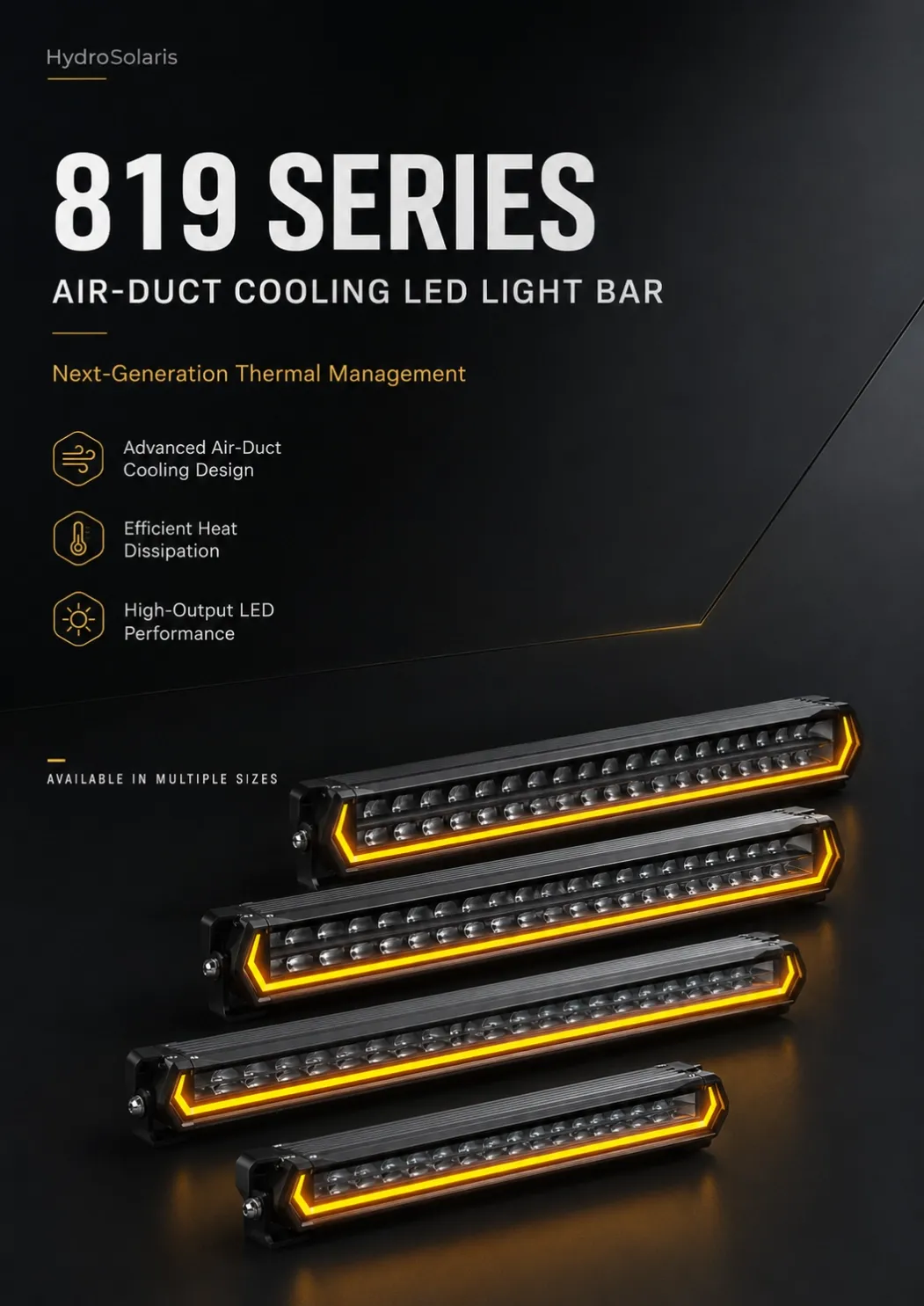
The 819A Series offers seven lengths built around a common 66.5 × 44 mm cross-section. The listed sizes are 373, 525, 677, 829, 981, 1,133 and 1,284 mm. That shared design language can help a buyer build a coherent range while choosing different lengths for different vehicle classes.
The business value is range control. Instead of stocking all seven models immediately, a distributor can analyze historic sales and approve two or three core lengths first. The remaining models can support project orders. This reduces slow-moving inventory without forcing customers into a single size.
Pain point 2: a lumen number does not guarantee useful light
Light-bar quotations often encourage buyers to compare only wattage or rated lumens. That is incomplete. Drivers and machine operators experience beam distribution, foreground brightness, reach, glare and uniformity—not a number on a spreadsheet.
The brochure lists the following rated outputs:
819A-373: 373 mm, 12 LEDs, 6,363 lm
819A-525: 525 mm, 18 LEDs, 8,190 lm
819A-677: 677 mm, 24 LEDs, 10,017 lm
819A-829: 829 mm, 30 LEDs, 11,844 lm
819A-981: 981 mm, 36 LEDs, 13,671 lm
819A-1133: 1,133 mm, 42 LEDs, 15,498 lm
819A-1284: 1,284 mm, 48 LEDs, 17,325 lm
Each LED is listed at 6W. Multiplying LED count by 6W gives 72W to 288W of calculated LED power across the range; this is not a substitute for measured electrical input. Before a bulk order, ask for current draw at the intended voltage and request photometric data for the exact optical configuration. Then test the beam on the target vehicle at normal mounting height.
This approach prevents overbuying. A shorter truck LED light bar with the correct beam may deliver better task visibility than a longer unit with excessive foreground light. Better specification can improve end-user satisfaction while reducing returns based on unrealistic brightness expectations.
Pain point 3: heat-related failures become warranty costs
High-output LEDs generate heat, and a long lamp has more components that must operate consistently. Poor thermal behavior can affect output stability, sealing materials and electronic life. For a brand owner, that becomes replacement freight, distributor credits, technician time and reputational damage.
The 819A housing incorporates an air-duct cooling structure. The feature matters because it provides an airflow path around the aluminum housing. Its business value is potential support for more stable thermal management, but buyers should not treat the shape alone as proof of service life.
A practical sample test includes continuous operation until temperatures stabilize, current measurement before and after the thermal soak, a hot-restart check and visual inspection of cables and seals. Run the test at the highest normal ambient temperature expected in the application. Record the method so future production lots can be compared with the approved sample.
Pain point 4: “wide voltage” can hide installation risk
The specified 10–48V DC input range makes the 819A platform relevant to common 12V, 24V, 36V and 48V vehicle systems. For importers serving several equipment sectors, this may reduce the need for separate voltage-specific product families.
However, voltage compatibility does not complete the electrical design. The longest model carries more LEDs than the shortest model, so wiring and protection decisions must be based on the actual configuration. Ask for measured current, recommended fuse size, wire gauge, connector, pinout and cable length. Confirm reverse-polarity behavior and review the applicable electromagnetic compatibility evidence.
The purchasing benefit is fewer installation complaints. A supplier and buyer who agree on the electrical interface before production are less likely to face field modifications, undersized harnesses or inconsistent connector requests across repeat orders.
Pain point 5: the wrong length creates fitment and logistics problems
Many fitment errors happen because teams choose a nominal inch size before checking the vehicle. Measure the available mounting width, bracket clearance, roof or bonnet curvature, cable route and the location of cameras, sensors and washer systems. Long housings also create greater leverage at the mounts, so bracket stiffness and vibration behavior deserve attention.
A shorter model can reduce package size, shipping volume and mounting stress. A longer model can expand optical coverage when the vehicle structure and use case justify it. The correct decision is based on the installation envelope and beam requirement, not simply the highest listed output.
For OEM programs, request a dimensional drawing and place it in the vehicle CAD or fitment drawing before ordering production samples. For distributors, publish accurate dimensions and recommend a physical clearance check. Both steps reduce “does not fit” returns.
Pain point 6: approval claims must match the ordered model
The 819A brochure lists ECE R10, R148 and R149. These references matter to buyers because electromagnetic compatibility and lighting-function rules may affect market access. A logo or regulation number in promotional material is not enough for a compliance decision.
Ask for the certificate or approval document, the approval marking, the covered model list and the exact function to which it applies. Confirm that the ordered length, lens, light function and production marking fall within scope. Local installation and use rules must also be checked in the destination market.
This verification reduces purchasing risk. It protects an importer from receiving stock that cannot be marketed with the expected claim and gives OEM teams the evidence needed for their own technical files.
How does the amber position light affect specification?
The 819A Series includes an amber position-light outline in addition to its auxiliary driving-light function. For a brand, this can create a recognizable visual signature across several lengths. For the installer, it adds another circuit and therefore another point that must be defined.
Confirm the wire assignment, switching logic and intended market use. Amber color, mounting location and operating logic can be regulated differently by country and vehicle class. The business value appears only when the feature is correctly documented and installed; otherwise it may create support questions or compliance risk.
Which B2B buyers are the best fit for the 819A Series?
Importers and regional distributors
They can use the seven-length family to cover several vehicle segments with a consistent appearance. Their main concerns are inventory turnover, repeatable quality, documentation and packaging accuracy.
Truck, 4×4 and off-road lighting brands
They may value the air-duct visual design, amber position light and multi-length range. Their approval process should focus on beam performance, branding requirements, installation hardware and after-sales consistency.
Agricultural and construction-equipment suppliers
The 10–48V range supports varied machine platforms. These buyers should prioritize vibration, dust and water exposure, cable routing, thermal operation and service access on the actual machine.
OEMs and vehicle upfitters
They benefit from a defined cross-section and multiple lengths, but require drawings, interface control and change management. The earlier these items are frozen, the lower the risk of production-line disruption.
Fleet and service-vehicle operators
They are interested in usable night visibility and reduced downtime. A controlled pilot installation is more valuable than selecting purely by headline lumens.
A practical sample-approval plan
Select one or two 819A lengths using the actual vehicle mounting envelope.
Confirm target voltage, wiring, fuse, connector and amber-position-light logic.
Review drawings and the exact ECE documents required for the destination market.
Measure current and observe output after continuous operation.
Evaluate the beam on the vehicle in the real work environment.
Inspect mounts, fasteners, cable strain relief and sealing after vibration or road testing.
Verify website-rated IP67 protection evidence for the complete installed interface.
Freeze the approved sample, label artwork, packaging and acceptance criteria.
Use a pilot order before scaling the full model range.
This sequence gives procurement, engineering and sales teams a common record. It also creates objective evidence when a later shipment is compared with the original approval.
What information should an RFQ include?
A precise RFQ usually receives a more precise quotation. Include the target vehicle or machine, destination market, required model length, system voltage, beam requirement, annual quantity, expected first-order quantity, connector and cable preference, amber-light operating logic, required approval documents, packaging requirements and private-label artwork needs.
Also state which tests must be passed before mass production and whether test reports, samples or golden units must be retained. This helps a heavy-duty LED light bar supplier quote the correct configuration rather than a generic lamp that later needs modification.
Frequently asked questions
Is a 10–48V LED light bar suitable for both 12V and 24V vehicles?
Yes, the specified range covers common 12V and 24V systems. Buyers must still confirm measured current, fuse selection, wire gauge and connector capacity for the selected length.
Which 819A length should a distributor stock first?
There is no universal best size. Review the most common vehicle widths, historic sales and shipping limits. Approving two or three core models often controls inventory better than launching all seven at once.
Does the air-duct design guarantee a longer service life?
No. It is a thermal-management design feature, not a lifetime guarantee. Verify temperatures, output stability and hot-restart behavior on production-intent samples.
Are the listed ECE approvals valid for every market and model?
The brochure lists ECE R10, R148 and R149, but buyers should review the actual documents and covered model scope. Road use also depends on local installation and vehicle rules.
What does IP67 mean for procurement?
IP67 is the maximum protection rating used on this website for the series. Buyers should request supporting evidence and confirm connector sealing and cable entry as part of the installed system.
Final purchasing perspective
The strongest reason to consider the 819A is not one headline specification. It is the possibility of building a controlled, multi-length LED light bar program around a common cross-section, wide voltage range, air-duct housing and amber position-light function.
That possibility becomes business value only after the buyer verifies fitment, beam performance, current draw, thermal behavior, sealing and document scope. Share the target vehicle, voltage, preferred length, market and forecast when requesting a quotation. A focused technical discussion at the RFQ stage can reduce samples, shorten approval cycles and prevent expensive changes after production begins.