Aug 14, 2026 LED Truck Driving Light
How to Source a Compact Amber LED Position Light | 814A Buyer Guide
A B2B guide to evaluating compact amber LED position lights for trucks: voltage range, flood beam, mounting, IP67, R10 scope, samples and warranty risk.
How to Source a Compact Amber LED Position Light Without Creating Warranty and Inventory Problems
An amber auxiliary lamp looks simple on a specification sheet. For an importer or vehicle-equipment buyer, however, a poor selection can create several expensive problems at once: the lamp may not fit the bodywork, the beam may not cover the intended area, the voltage version may fragment inventory, the bracket may corrode, or the compliance paperwork may not match the product received.
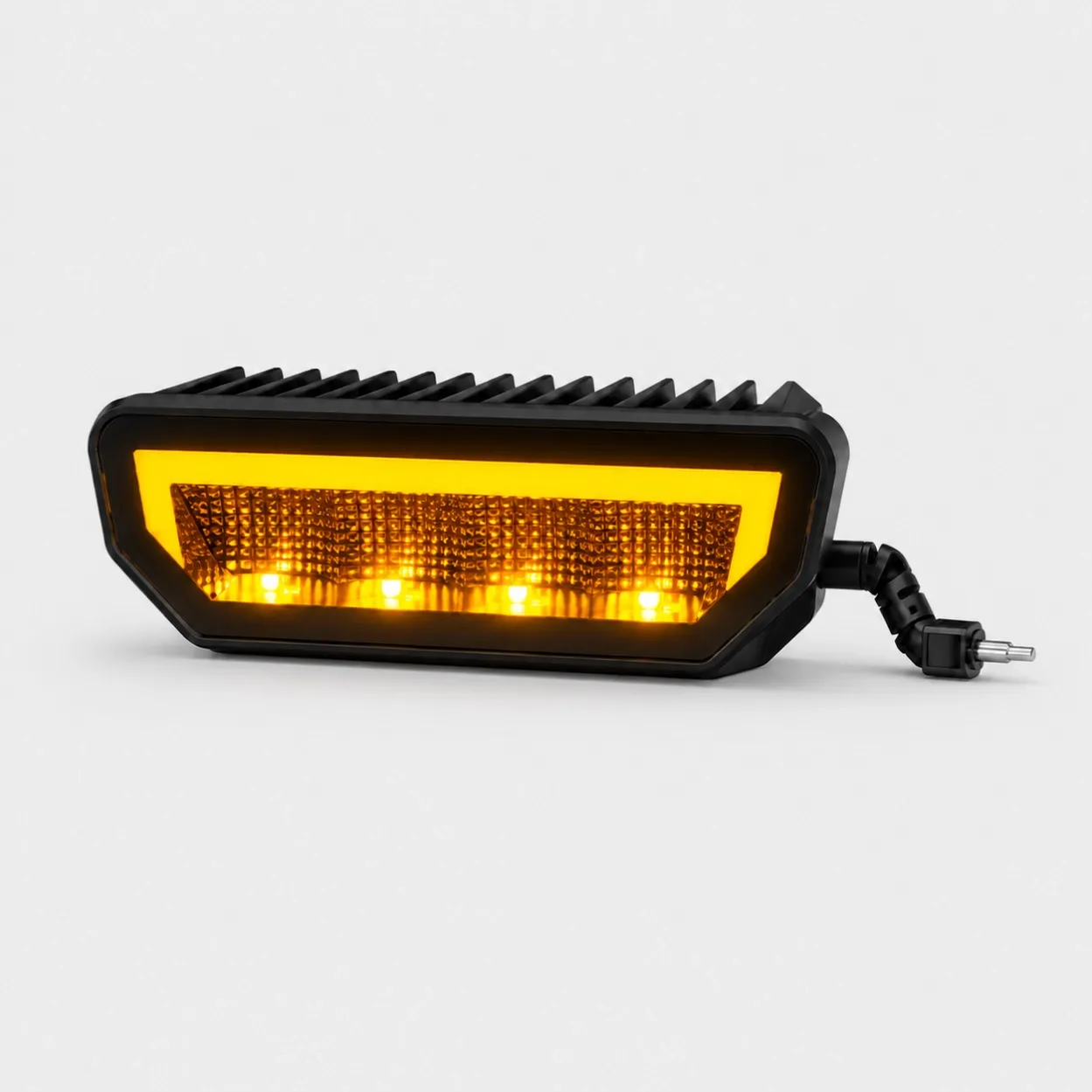
This guide explains how to evaluate a compact amber LED position light for truck, pickup, trailer and special-vehicle programs. The 814A is used as a practical specification example: 24W, 2400 lm, 10–48V DC, flood beam, 171.5 × 70 × 48 mm, aluminum housing, PC lens, 304 stainless-steel bracket, OSRAM LEDs, IP67 and brochure-listed R10.
The goal is not to declare one lamp suitable for every vehicle. It is to show B2B buyers how to reduce approval risk before a production order.
Question 1: “Can one amber light cover several vehicle platforms?”
This is one of the first questions asked by distributors managing 12V pickups, 24V trucks and higher-voltage special equipment.
A 10–48V DC input range can reduce the number of voltage-specific SKUs. That creates three purchasing benefits:
• Forecasting becomes easier because demand is not split across several electrical versions.
• Warehouse teams have fewer nearly identical part numbers to control.
• Dealers are less likely to ship a 12V-only lamp into a different vehicle program.
The voltage range is still not a substitute for validation. Buyers should test start-up behavior, switching logic, cable protection and electrical transients on the actual platform. If R10 documentation is required, check that the certificate scope matches the product and the target market.
Question 2: “Why does a 24W, 2400 lm light still need an on-vehicle test?”
Wattage tells you electrical power. Luminous flux gives a total-light reference. Neither number alone tells you whether the driver, operator or surrounding traffic will see useful light in the required area.
The supplied 814A specification identifies a flood beam. A flood beam is intended to distribute light across a wider nearby area instead of concentrating it into a narrow long-range hotspot. That can be useful for auxiliary positioning and near-field recognition, but the final result depends on mounting height, angle and nearby bodywork.
A simple sample test should record:
- Mounting height and orientation.
- Visible coverage from the required viewing positions.
- Reflections from the hood, mirrors, rack or painted body panels.
- Appearance in rain, dust and low ambient light.
- Whether the amber function is appropriate for the destination market.
This test is more useful than comparing a single “lumens” number from two suppliers.
Question 3: “Will the lamp fit without a custom bracket?”
Mechanical fit is a frequent source of delayed projects. The 814A measures 171.5 × 70 × 48 mm. Those three numbers should be checked against the complete installation envelope, not only the front opening.
A buyer should also account for:
• Cable and connector bend radius behind the light.
• Space for a tool to reach the bracket fasteners.
• Clearance from a hood, door, canopy, guard or equipment arm.
• Water paths around the cable entry.
• Vibration at the selected mounting point.
The supplied specification lists a 304 stainless-steel bracket. This matters because bracket corrosion or loosening can cause service complaints even when the LED circuit still works. During sample approval, inspect the bracket, fastener access and the way cable strain is transferred to the housing.
Question 4: “What does IP67 mean for purchasing?”
The declared website protection level is IP67. For procurement, the important point is that the rating applies to the product configuration that was tested; it does not guarantee that every connector, splice or installation method is equally protected.
Ask the supplier to clarify:
• How the cable exits the housing.
• Which connector is supplied or recommended.
• Whether any sealing steps are required during installation.
• Which orientation was used for validation.
• How the product should be mounted to avoid standing water.
A buyer can reduce warranty disputes by documenting these details before mass production. Do not assume that a higher number shown in marketing artwork automatically covers the final vehicle installation.
Question 5: “Is brochure-listed R10 enough for my market?”
No single certificate reference should be accepted without checking its scope. The supplied brochure lists R10. A responsible buyer should request the available documentation, confirm the exact model reference and verify whether it is acceptable for the intended market and vehicle function.
This is especially important when a lamp is sold through multiple channels. Product naming, private-label packaging and connector changes can create questions during market surveillance or customer audits. Keep the approval record linked to the exact configuration you purchase.
Which B2B customers are the best fit?
Importers and distributors
They may value the broad input-voltage range because it can reduce inventory fragmentation. Their main concerns are usually consistent specifications, reliable replenishment, clear packaging, batch traceability and a low return rate.
Brand owners
They need a product that can be described accurately across catalogs, online listings and dealer training. Defined dimensions, power, output and materials make it easier to create controlled product data. They should also settle logo, label and packaging requirements before the pilot order.
Truck-body builders and equipment manufacturers
Their priority is integration. They will focus on the mounting envelope, bracket access, cable routing and whether the amber light performs the intended function on the completed vehicle.
Fleet upfitters
They often need repeatable installation across mixed vehicles. A wide voltage range can help, but standard operating procedures for mounting, wiring and inspection are equally important.
A practical sample-approval workflow
Step 1: Define the vehicle and legal function
Write down the vehicle type, target country, mounting position and intended use of the amber light. Avoid ambiguous descriptions such as “universal warning light” unless the product is actually specified and approved for that function.
Step 2: Approve the mechanical package
Check the 171.5 × 70 × 48 mm dimensions, bracket angle, fasteners, cable exit and connector. Use real bodywork or a representative fixture.
Step 3: Verify optical usefulness
Evaluate the flood distribution at the planned mounting height. Record photographs and observations from the viewing positions relevant to the application.
Step 4: Validate the electrical system
Test the target voltage range, switching behavior, cable protection and any required EMC checks.
Step 5: Review documents and labeling
Match the product model to the available R10 documentation, packaging label, carton label and traceability code.
Step 6: Run a pilot order
A small controlled order lets the buyer confirm assembly consistency, packaging protection, installation time and dealer feedback before committing to larger stock.
Common sourcing mistakes
Mistake: Choosing by wattage alone.
Business impact: The lamp may consume the expected power but distribute light poorly for the application.
Mistake: Ignoring the space behind the housing.
Business impact: Installers modify brackets or bend cables sharply, increasing labor and failure risk.
Mistake: Treating the voltage range as automatic vehicle approval.
Business impact: Electrical behavior may not be verified on the real platform.
Mistake: Copying a protection rating without checking the final installation.
Business impact: Warranty disputes occur when connectors or splices allow water ingress.
Mistake: Ordering private-label packaging before sample approval.
Business impact: Printed materials become unusable if specifications or installation instructions change.
RFQ information that produces a useful quotation
A serious B2B inquiry should include:
• Target vehicle and market.
• Annual volume and expected first order.
• Mounting position and available space.
• Required cable length and connector.
• Packaging, logo and label requirements.
• Required compliance documents.
• Sample-test schedule and target launch date.
This information allows the supplier to identify risks before pricing and reduces unnecessary sample revisions.
FAQ
Is the 814A a warning light?
The supplied material describes it as an amber position light with a flood beam. Buyers must confirm whether the intended road or worksite function is permitted in their market.
Can it be used on both 12V and 24V vehicles?
The brochure specifies 10–48V DC. Actual compatibility should be validated on the target electrical system.
What is the declared waterproof level?
The website states IP67. Connector sealing and installation quality remain part of the final vehicle design.
How should a buyer compare suppliers?
Compare the exact model, sample output, dimensional consistency, housing and bracket quality, documentation scope, packaging protection, traceability and response to technical questions—not only price and wattage.
Conclusion
A compact amber LED position light can reduce SKU complexity and solve a difficult installation problem, but only when the specification is connected to a disciplined approval process. For the 814A, the 10–48V DC range, flood beam, compact aluminum housing and stainless-steel bracket address practical purchasing concerns. The business value comes from verifying those features on the intended vehicle, documenting the accepted configuration and controlling it through production and delivery.