Aug 14, 2026 LED Truck Driving Light
Red LED Rear Position Light: 8 Checks Before OEM Approval | 814B
Eight B2B checks for sourcing a red LED rear position light: legal function, fit, voltage, beam, IP67, R10 scope, pilot orders and warranty control.
Red LED Rear Position Light Sourcing: Eight Checks Before OEM or Fleet Approval
A red LED lamp is a regulated vehicle component in many markets, not simply a red version of a work light. Importers and OEM buyers must confirm where it will be installed, what function it performs, which viewing angles matter and whether the supporting documents match the exact supplied model.
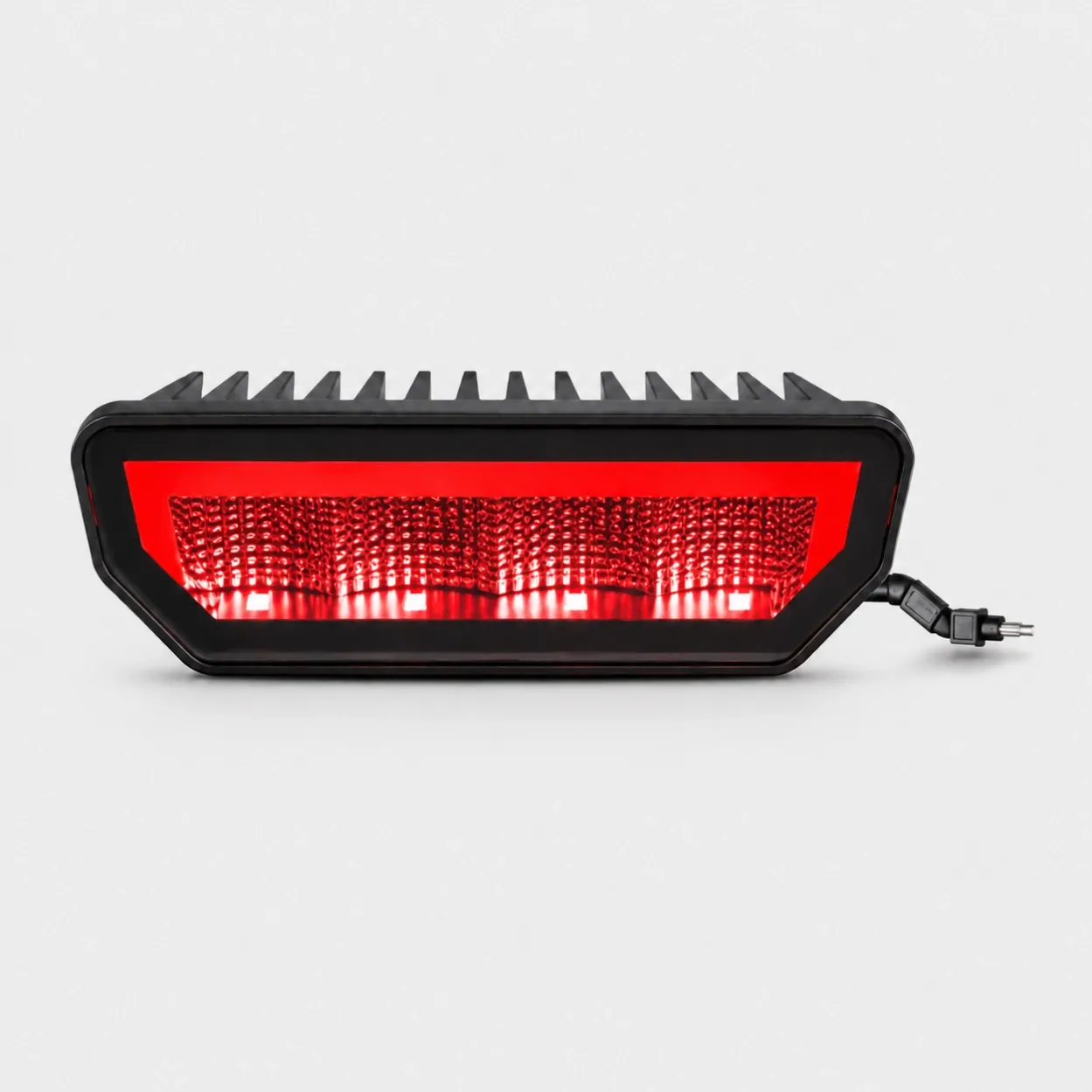
This article uses the 814B as a practical specification example. The supplied product information lists an 18W red position light with 1800 lm, 10–48V DC input, flood beam, OSRAM LEDs, aluminum housing, PC lens, 304 stainless-steel bracket, 136.5 × 70 × 48 mm dimensions and brochure-listed R10. The website declares IP67.
The purpose is to help B2B buyers reduce purchasing risk. It is not a statement that the lamp is automatically legal in every location or suitable for every rear-lighting function.
A common RFQ scenario
A distributor asks for “a universal red LED light for pickup roofs and truck bodies.” The requested annual quantity is attractive, but the buyer has not stated the country, mounting position, legal function, connector or cable length.
Quoting immediately creates risk. “Red light” may refer to a position lamp, marker, identification light, brake-related function or an off-road auxiliary use. Each can have different rules and performance expectations.
The correct first response is a short qualification checklist:
• In which country will the product be sold?
• What vehicle types are involved?
• Where will the lamp be mounted?
• Which function will it perform?
• Is the lamp used on public roads, private worksites or both?
• Which certificate and labeling documents are required?
• What connector, cable length and packaging are expected?
Only after these questions are answered can the supplier and buyer evaluate fit, sample scope and documentation.
Check 1: Define the legal function before comparing price
Color alone does not define function. A red lamp mounted at the rear of a vehicle may be subject to rules about position, spacing, height, intensity and activation.
The 814B material describes a red position light. Buyers should avoid marketing it as a universal brake, tail, warning or identification lamp unless those functions are supported by the product documentation and destination-market requirements.
Business value: Clear function definitions prevent incorrect catalog claims, customs questions, dealer complaints and stock that cannot be sold legally.
Check 2: Verify the mounting envelope, not just the face width
The 814B measures 136.5 × 70 × 48 mm. The compact width can help when a truck body, canopy, roof rail or equipment structure offers limited space. The full installation envelope must include the bracket, cable exit, connector bend and tool access.
Questions for the drawing review:
- Is there enough space behind the housing?
- Can an installer reach the fasteners?
- Will the cable rub against a body edge?
- Does the planned angle preserve visibility?
- Can water collect around the cable entry or bracket?
Business value: A proper fit review reduces improvised brackets, installation delays and field damage caused by tight cable routing.
Check 3: Treat 10–48V DC as an inventory benefit, not an approval shortcut
A broad input range can help importers serve 12V, 24V and other low-voltage commercial-vehicle platforms with one version. That reduces split inventory and the chance of dealers shipping the wrong voltage variant.
However, buyers should still test:
• Start-up and switching behavior.
• Voltage variation on the target vehicle.
• Cable and fuse protection.
• Electrical transients.
• EMC requirements for the intended market.
Business value: The range can simplify SKU planning, while vehicle-level validation reduces warranty disputes and intermittent electrical complaints.
Check 4: Use the beam and output figures as a starting point
The 814B is listed at 18W and 1800 lm with a flood beam. A flood beam distributes light across a broader nearby area than a narrow spot beam. For a position-light application, visibility from the required directions matters more than creating a distant hotspot.
An on-vehicle sample test should check the red illuminated appearance from the rear and relevant angles, as well as reflections from the canopy, roof, body paint or nearby lamps.
Business value: Testing the installed optical result reduces the risk of approving a product that photographs well but performs poorly on the final vehicle.
Check 5: Separate the lamp rating from the complete installation
The website declares IP67. That rating should be understood together with the cable entry, connector, splice, mounting orientation and installation instructions.
A sealed housing can still fail in service if:
• The connector is not protected.
• A cable splice sits in a water path.
• The cable is bent sharply at the housing.
• Installation damage compromises the seal.
• Pressure washing is applied outside the validated conditions.
Business value: Defining connector and installation responsibilities before shipment reduces arguments about whether a field failure is a product, wiring or installation issue.
Check 6: Inspect the housing and bracket as warranty-control components
The supplied specification lists an aluminum housing and a 304 stainless-steel bracket. Aluminum supports heat dissipation and gives the assembly a rigid structure. The stainless-steel bracket addresses corrosion risk at the mounting point.
These materials still need sample inspection. Buyers should look for finish consistency, bracket thickness, fastener access, cable strain relief and whether the mounted lamp stays stable under vibration.
Business value: Mechanical quality affects return rates, installation time and customer confidence just as much as LED output.
Check 7: Verify R10 scope before making compliance claims
R10 is listed in the supplied brochure. A buyer should request the supporting documentation, check the model reference, confirm the configuration and verify acceptance for the target market.
Private-label programs require additional control. Product labels, packaging and technical files should remain traceable to the approved model. If connectors, electronics or other controlled elements change, the impact on documentation should be reviewed.
Business value: Proper document matching reduces regulatory and market-surveillance risk and prevents unsupported claims in catalogs.
Check 8: Build a measurable pilot-order plan
Do not jump from one visual sample to a large private-label order. A pilot order should define what will be checked and who will approve it.
A practical pilot plan can include:
• Dimensional and mounting consistency.
• Red output and illuminated appearance.
• Operation across target voltage platforms.
• Cable, connector and bracket inspection.
• Packaging drop protection.
• Carton and product labeling.
• Batch traceability.
• Installation time on representative vehicles.
• Agreed water, thermal and vibration checks.
Business value: A pilot converts assumptions into evidence and gives the supplier a clear standard for mass production.
Pain points by buyer type
Importers and distributors
Their biggest risks are unsellable stock, inconsistent shipments, incomplete documents and dealer returns. They may value the 10–48V DC range because it can reduce voltage variants, but they should insist on a stable bill of materials and traceable production.
Brand owners
They need controlled product data and packaging claims. The defined 18W, 1800 lm and 136.5 × 70 × 48 mm specification supports catalog management, while careful R10 wording and IP67 disclosure reduce claim risk.
Truck-body builders and equipment manufacturers
They care about integration. Mechanical drawings, bracket access, cable routing and visibility on the completed body are more important than a generic “universal fit” statement.
Fleet upfitters
They need repeatable installation and service procedures. A standardized connector, cable path and mounting inspection can reduce labor variation across vehicles.
Heavy-truck and pickup accessory dealers
They need products that installers can understand quickly and that customers can use in permitted applications. Clear installation guidance reduces fitment disputes at the counter.
Questions buyers should ask a supplier
- Can you provide the exact 814B drawing and sample specification?
- What does the supplied R10 documentation cover?
- Which connector and cable options are available?
- How is batch traceability handled?
- Which dimensions and electrical checks are performed before shipment?
- How are changes to LEDs, drivers, housings or connectors controlled?
- What packaging is used to protect the lens and bracket?
- What information is needed for private-label production?
- What sample and pilot-order lead times should be planned?
- How are technical questions and warranty investigations handled?
A supplier’s answers should be specific enough to become part of the approval record. Vague promises such as “high quality” or “fully waterproof” are not useful purchasing controls.
How to prepare a high-quality RFQ
Include the following information:
Target market: Country or region where the vehicle and product will be sold.
Vehicle/application: Truck, pickup, trailer, body, canopy or special equipment.
Function: Exact intended red-light function.
Mounting: Photos, drawings, available space and desired angle.
Electrical: Nominal system voltage, switching method, connector and cable length.
Compliance: Required certificates, labels and technical documents.
Commercial: Annual volume, first-order quantity and target launch date.
Branding: Logo, packaging, barcode and language requirements.
Validation: Tests and sample-approval criteria.
A complete RFQ helps the supplier price the correct configuration and often shortens the sampling cycle.
FAQ
Is 814B a complete rear combination lamp?
No. The supplied material identifies it as a red position light. It should not be described as providing unrelated rear-lamp functions without supporting evidence.
Can it be mounted anywhere on a pickup or truck?
No. Mounting location and permitted use depend on local rules and the vehicle function. Buyers should validate the proposed installation.
Why publish IP67 when brochure artwork shows a higher rating?
The website uses a maximum protection claim of IP67. The complete installation must also address connector and cable sealing.
Does 1800 lm guarantee legal compliance?
No. Luminous flux is only one technical reference. Compliance can depend on function, intensity distribution, color, mounting and documentation.
What creates the most warranty risk?
Poor connector sealing, incorrect installation, uncontrolled component changes, weak bracket or cable routing, and an unclear approval standard can all create warranty exposure.
Conclusion
The best red LED rear position light is not simply the brightest or lowest-cost option. It is the product whose function, dimensions, electrical behavior, materials, sealing expectations and documentation can be verified for the target vehicle and market.
The 814B offers a compact 136.5 mm format, 10–48V DC coverage, defined 18W and 1800 lm output, aluminum housing, PC lens and stainless-steel bracket. Those features create business value only when they are connected to an on-vehicle sample test, document review, pilot order and controlled production standard.