Jul 22, 2026LED WORK LIGTH
What Causes LED Work Light Fitment Problems in Tight Machinery Spaces?
A B2B troubleshooting guide for compact machinery work-light fitment. It explains mounting envelope, aiming, wiring, heat, service access and sample approval using a 12W-class square lamp example.
What Causes LED Work Light Fitment Problems in Tight Machinery Spaces?
A compact LED work light is often purchased because the machine has little room around a cab, guard, implement or service compartment. The purchasing mistake is to compare only the lamp’s front dimensions. Fitment problems usually come from the bracket, adjustment arc, wire exit or surrounding structures.
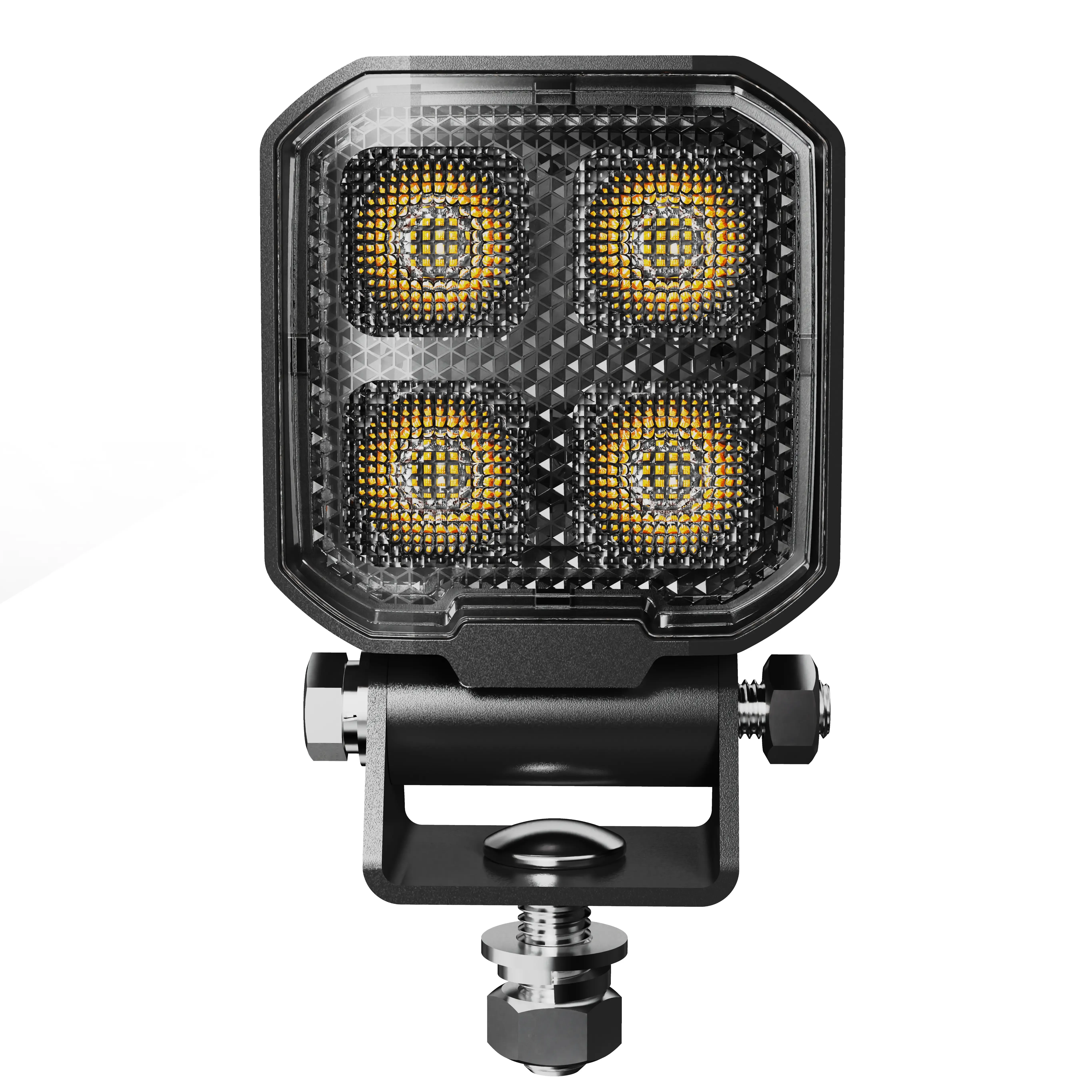
The WN12C is a compact square design with four visible optical LED modules and an adjustable U-bracket. Estimated nominal power is 12W, based on four modules at approximately 3W each. Estimated effective output is about 840 lumens. The figures are planning estimates, not certified measurements.
Problem 1: The drawing ignores the full mounting envelope
A lamp may fit when viewed from the front but collide with the machine when tilted. Buyers should request a three-dimensional envelope that includes the housing depth, bracket, bolt, wire exit and full adjustment range.
For an OEM, this prevents late drilling changes and interference with panels. For a distributor, clear dimensions reduce returns from customers who selected by face size alone.
Problem 2: The bracket cannot reach the required angle
An adjustable U-bracket is useful only if its movement covers the needed work zone. Test the lamp at the real installation height. Check whether the bracket slips under vibration and whether the fastener remains accessible to an installer.
The technical benefit is aimability. The business value is shorter installation time and fewer field corrections.
Problem 3: Wiring is treated as an afterthought
A cable can be damaged if the wire exit is pressed against a panel or routed across a moving part. The buyer should specify wire length, connector, polarity, strain relief and bend space. If the machine platform uses several harness versions, decide whether the lamp or an adapter will carry the variation.
Good wiring definition reduces assembly errors and warranty investigations.
Problem 4: A higher-output lamp creates more heat than the space can manage
Tight spaces may have limited airflow. A compact lamp should be tested at the maximum intended voltage and ambient temperature. Ask for actual current and temperature-rise data. The WN12C’s estimated 12W class may be appropriate where electrical load and packaging are constrained, but thermal performance still requires validation.
Problem 5: The buyer has not defined the working distance
A service compartment, near-field implement area and forward work zone require different optical behavior. An estimated 840 lumens does not tell the buyer where the light will land. Compare beam samples at the real distance and observe reflections from nearby panels.
Problem 6: Service access is blocked
Maintenance teams need access to filters, covers, bolts and connectors. A lamp that fits during assembly may make future service slower. Include removal clearance and tool access in the installation review. This converts a small design detail into lower lifecycle labor cost.
A compact-machinery case scenario
Consider an equipment manufacturer adding a work light beside a narrow guard. The initial goal is simply “less than a certain width.” A better process starts with a marked-up drawing showing the desired work area, allowable envelope, bolt location, wire route and service access.
The supplier provides a sample and dimension drawing. The engineering team installs it, sweeps the full adjustment range and runs the machine through vibration and temperature conditions. The purchasing team then records the approved bracket, wiring, beam and appearance as a golden sample.
What should an RFQ request?
Include model, target voltage, measured power, current, actual photometric data, beam requirement, drawing, bracket and fastener, wire or connector, environmental tests, EMC needs, label, packaging and change control. Mark all estimated values as estimates until testing is complete.
The WN12C is a practical 12W-class option for tight machinery spaces because it provides a compact format and adjustable bracket. Its real value will depend on fitment discipline and sample verification, not on a single lumen number.