Oct 23, 2026LED WORK LIGTH
LED Work Lights for Tractors and Heavy Equipment: B2B Buying Guide
Compare 18–96W LED work lights for tractor and heavy-equipment ranges. A distributor guide to 10–48V supply, flood beams, mounting, sample tests and OEM sourcing.
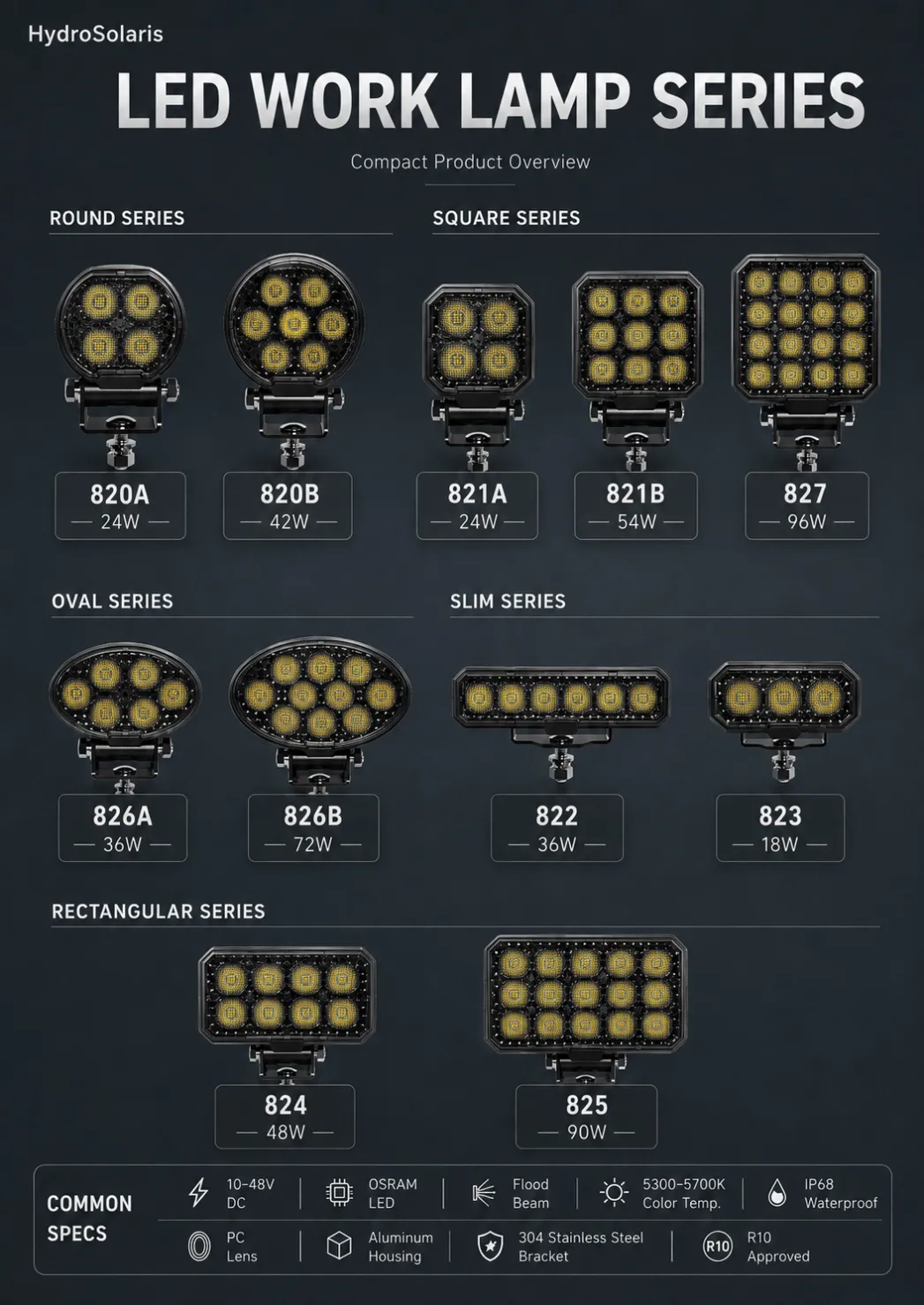
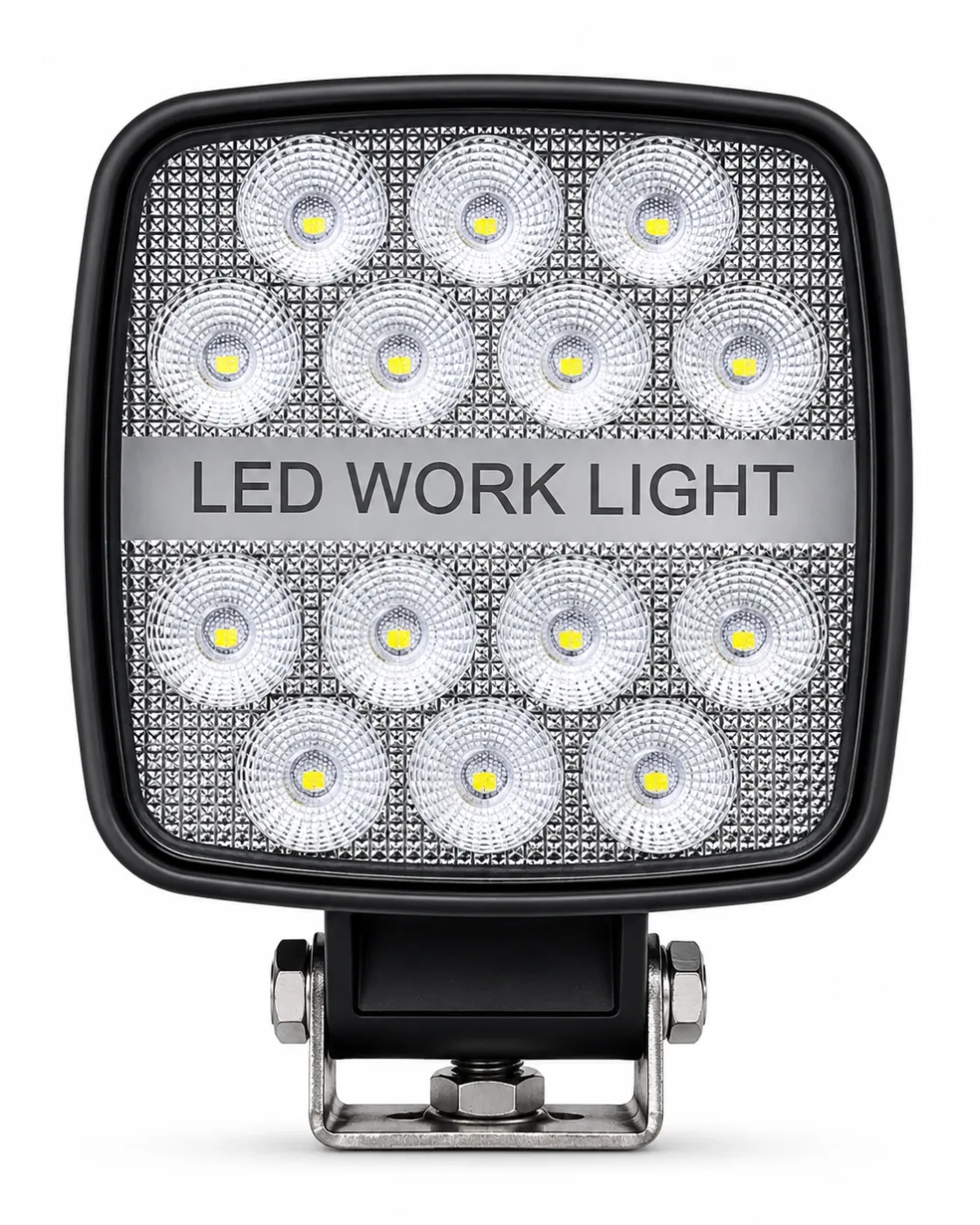
For importers, distributors and equipment brands: choose LED work lights by the working area, mounting envelope, electrical system and verified beam performance before comparing wattage. HydroSolaris's 820–827 work-lamp series offers eleven models from 18W to 96W across round, square, oval, slim and rectangular housings. This guide explains how to turn those options into a focused machinery-lighting range.
Which LED work light fits your customer’s equipment?
Tractor rear work areas, excavator service zones and truck-body workspaces need different mounting positions and coverage. Start with the task and installation drawing. A housing shape does not determine its beam, and a higher wattage does not automatically give better visibility at the required distance.
For close working areas, flood-beam coverage can help illuminate a wider zone. Ask for a lux map at your intended mounting height and distance. Check glare for the operator, reflections from implements and shadows from machine components. Do not assume that a work lamp is approved for use as an on-road driving lamp.
Compare the HydroSolaris 820–827 work-lamp series
The following model names and rated powers come from the HydroSolaris LED Work Lamp Series overview. Application suggestions are starting points for sample evaluation, not guarantees of vehicle fitment.
Housing | Model / rated power | What a buyer should evaluate |
|---|---|---|
Round | 820A: 24W; 820B: 42W | Cab or bracket clearance, aiming range and task-area coverage. |
Square | 821A: 24W; 821B: 54W; 827: 96W | Mounting space, thermal conditions and wiring capacity across three output tiers. |
Oval | 826A: 36W; 826B: 72W | Horizontal fit and coverage around implements or vehicle-body work areas. |
Slim | 822: 36W; 823: 18W | Low-profile mounting locations and clearance behind guards or equipment structures. |
Rectangular | 824: 48W; 825: 90W | Available bracket space, mounting strength and coverage at the required working distance. |
The supplied series overview lists 10–48V DC, OSRAM LEDs, flood beam, 5300–5700K color temperature, PC lens, aluminum housing, 304 stainless-steel bracket, IP68 waterproofing and R10 approval. Request the model-specific datasheet and matching test or approval documents before purchase. Effective lumens, dimensions, beam angle, connector, cable length, warranty and MOQ are not specified in the overview and should be confirmed in the quotation. |
12V, 24V and 48V machinery: check the full electrical requirement
A stated 10–48V DC input range covers nominal 12V and 24V systems, but system transients, charging voltage, wiring and protection still need evaluation. A nominal 48V system can operate above 48V when fully charged. Do not approve that installation from the nominal voltage alone: confirm the actual continuous maximum voltage and the lamp’s validated limits.
Rated power also affects harness planning. As a simple estimate, a 96W lamp draws 8A at 12V or 4A at 24V; four such lamps total about 32A at 12V. These are power/voltage calculations, not measured current specifications. Use confirmed operating current, start-up behavior, duty cycle and cable length to select the fuse, relay, switch and wire size.
Waterproofing, EMC and durability: what evidence should a distributor request?
IP68: ask for the test report, immersion depth and duration, and whether the connector and cable entry are included. An IP68 label alone does not establish resistance to every pressure-washing or chemical-cleaning process.
R10: verify that the approval number and document cover the exact model and version. R10 concerns electromagnetic compatibility; it is not proof of road-driving beam approval, lumen output or machine fitment.
Mechanical durability: review the mounting drawing, bracket fastener requirements, vibration testing and corrosion exposure. A 304 stainless-steel bracket is a material specification, not a substitute for testing the complete installation.
How distributors can build a useful work-light range
A practical initial range can cover three customer needs: compact supplementary lighting, general machinery work lighting and larger task-area installations. Evaluate the 18–24W options for space-sensitive jobs, the 36–54W models for a middle tier and the 72–96W models where the installation supports a higher electrical and thermal load. Confirm each tier with beam measurements rather than treating power as brightness.
This gives agricultural-parts distributors, construction-equipment suppliers and commercial-vehicle accessory brands a way to serve different mounting envelopes without stocking every model at launch. Select a small pilot range, record returns and installer feedback, and add sizes only when customer demand justifies the inventory.
For private-label programs, discuss logo marking, packaging, connectors, cable length and mounting requirements with HydroSolaris. Availability, development work, MOQ, lead time and cost must be confirmed for each project. See our OEM / ODM development support.
Sample approval checklist before a volume order
- Define machine type, target market, task, mounting height and working distance.
- Check dimensions, bracket travel, connector space and service access against the installation drawing.
- Compare measured lux coverage, glare and usable illumination after thermal stabilization.
- Test the actual electrical system, including its maximum continuous voltage.
- Review the exact IP and EMC documents and agree on relevant vibration and corrosion tests.
- Approve sample construction, marking, packaging and a repeatable inspection specification.
- Agree on quotation terms, MOQ, delivery schedule and warranty handling before the pilot order.
Frequently asked questions
What should a buyer compare when selecting tractor LED work lights?
Compare mounting fit, beam coverage at the required distance, operating voltage, electrical load, durability evidence and serviceability. Wattage alone is insufficient.
Is a 96W work light always better than a 24W model?
No. The correct choice depends on the task, beam distribution, mounting space and electrical capacity. A compact 24W unit may suit a local task where a larger lamp creates glare or installation problems.
Can these lamps be used on a nominal 48V vehicle?
The series overview states 10–48V DC. Confirm the vehicle’s maximum operating and charging voltage before selecting a model; nominal 48V does not mean the system stays below 48V.
Does R10 approval mean a work light is road legal as a driving light?
No. R10 addresses electromagnetic compatibility. The legal function and any other applicable approvals must be checked separately for the intended market and installation.
Who should contact HydroSolaris about this series?
Agricultural and construction-equipment parts distributors, commercial-vehicle lighting importers and brands planning an OEM or private-label work-light range. HydroSolaris LED Auto Light Mfg. supports LED automotive-lighting sourcing and OEM/ODM project discussions.
Request a focused work-light recommendation
Request Product Recommendation: send your company, country, machine/application, preferred models, installation drawing or dimensions, voltage range and expected quantity. Ask for a model-specific datasheet, sample plan and quotation.
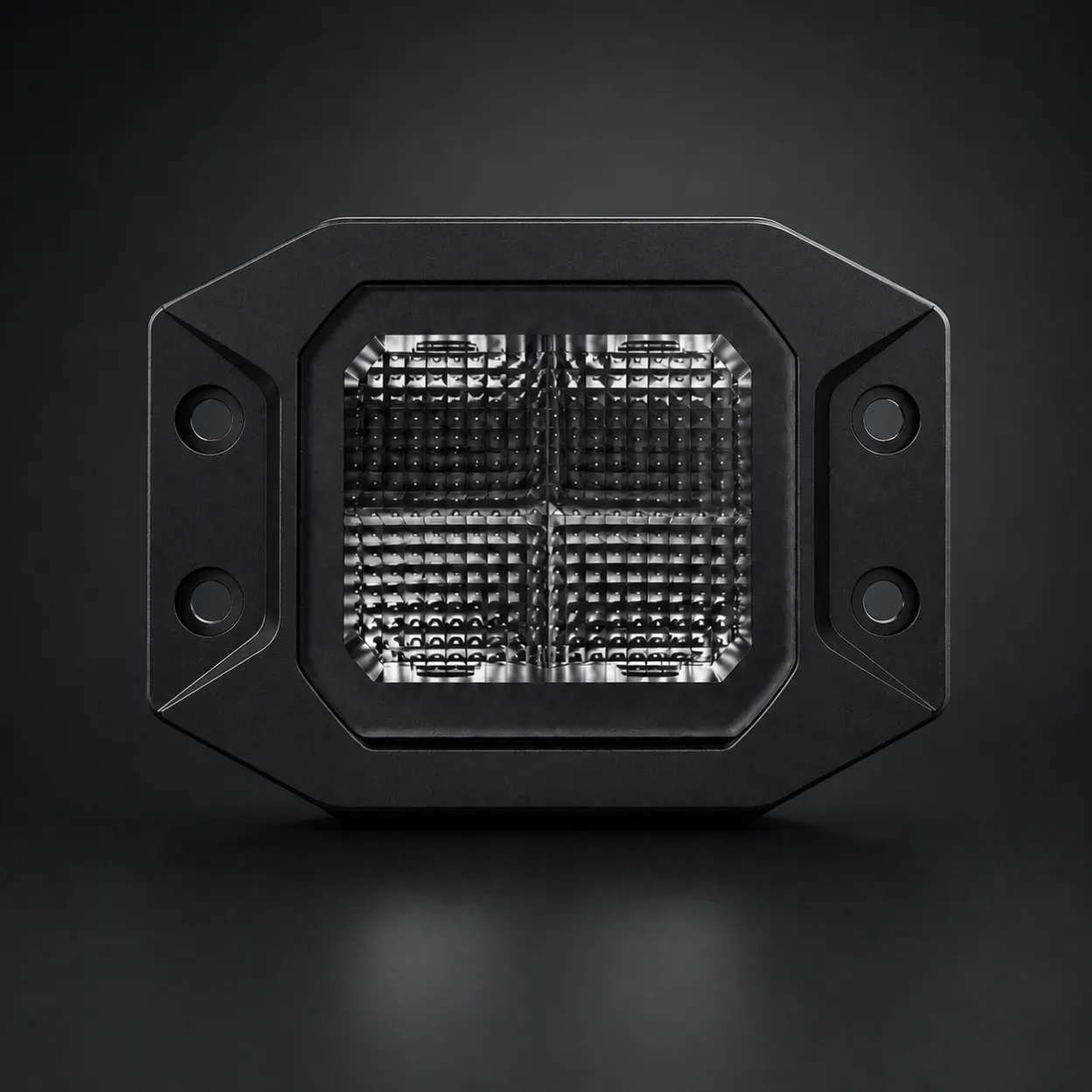
Explore our Agricultural & Work Lighting Solutions, 815A surface-mount flood work light and 815B recessed flood work light for alternative mounting formats. These are separate products; their specifications do not apply to the 820–827 series. Browse the complete HydroSolaris online catalog for the broader product range and contact us for the latest 820–827 series information.