Aug 14, 2026LED WORK LIGTH
How to Specify a Recessed LED Spot Work Light for Heavy Equipment
A B2B sourcing guide to long-range beam targets, panel integration, sealing and approval checks for recessed LED spot work lights.
How to Specify a Recessed LED Spot Work Light for Heavy Equipment
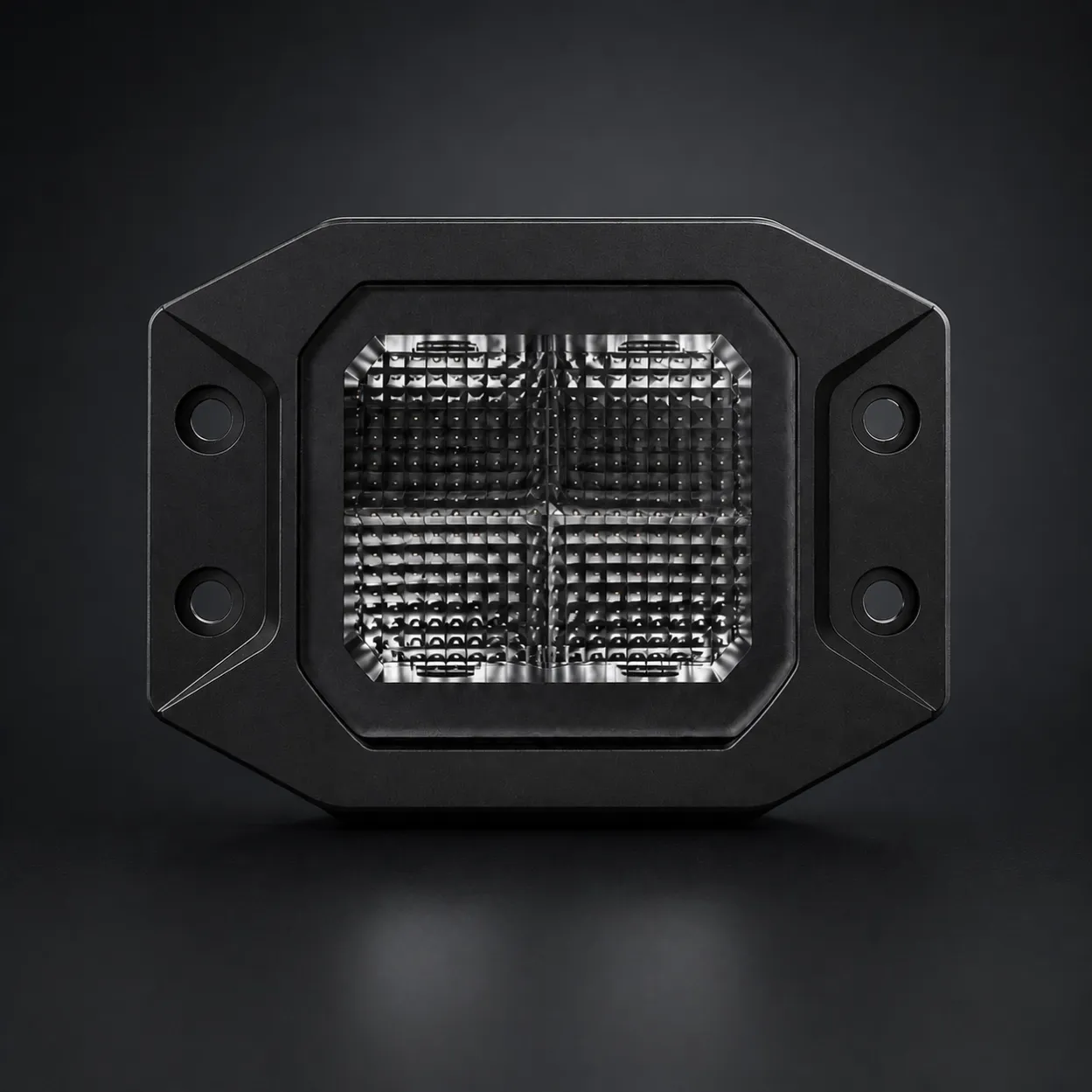
Heavy-equipment buyers sometimes need focused visibility without a lamp protruding from the body. A recessed spot work light can combine a low-profile installation with a narrow optical target, but it requires both panel engineering and beam validation.
The 815D is a 24W recessed-mount LED spot work light with 2400 lm brochure-rated output, 10–48V DC input, OSRAM LEDs, 5300–5700K color temperature, aluminum housing, PC lens and a four-hole flange. Its listed dimensions are 140.3 × 70 × 100.3 mm. This website uses IP67 as the maximum protection rating. The brochure lists R10 and a service-life reference up to 60,000 hours; confirm exact evidence and model scope.
Define the Target Before the Cutout
A spot beam is intended for a narrower, longer-distance target. A recessed installation fixes the lamp position more permanently than an adjustable external bracket. The target direction and panel angle must therefore be decided before the panel is cut.
Document the required distance, target width, mounting height and vehicle attitude during operation. A loader, service truck and recovery vehicle can aim at very different zones.
Pain Point 1: Correct Lamp, Wrong Panel Angle
A suitable spot optic can still miss the target if the panel points too high, low or sideways. Because the 815D is recessed, adjustment may be limited after installation.
Build a sample panel or fixture at the production angle. Test it on the machine at night and under normal load. If the beam misses the target, correct the panel or mounting design before tooling is frozen.
This avoids field modifications and reduces the risk of operators adding unauthorized lamps.
Pain Point 2: Cutout and Depth Errors Stop Production
The 815D dimensions are 140.3 × 70 × 100.3 mm, with brochure tolerance of ±1 mm. Buyers need the cutout, hole positions, internal depth and cable clearance—not only overall dimensions.
Check nearby hydraulic lines, reinforcement ribs, hinges and service panels. Confirm that technicians can remove and reconnect the lamp without dismantling unrelated components.
The business value is lower assembly time and fewer scrapped or reworked panels.
Pain Point 3: Headline Lumens Do Not Prove Target Visibility
The brochure lists 2400 lm at 24W. A spot-beam decision should use photometric intensity or an installed beam test. Lumens alone cannot predict lux at a specific distance.
Request measured data for the exact optical configuration. Test the beam against the real work target and record the result. This supports a defensible approval instead of a marketing comparison.
Pain Point 4: Recessed Thermal Conditions Differ From Open Air
A lamp placed behind a panel may have less airflow around the aluminum housing. Run a continuous-operation thermal check in the production-intent cavity.
Measure current and temperature after stabilization, then perform a hot restart. Check that cables are protected from sharp edges and heat sources.
This can reduce electronic failures, connector damage and warranty labor.
Pain Point 5: Sealing Depends on the Panel Interface
The website lists IP67 maximum. The installed system includes the lamp, flange, fasteners, panel, cable entry and connector.
Define gasket or sealant, fastener torque and drainage. Test the complete installation after vibration. This is more meaningful than accepting a rating without installation conditions.
Pain Point 6: Wide Voltage Requires Controlled Wiring
The 10–48V DC range supports common 12V, 24V, 36V and 48V platforms. For an equipment group with several voltages, that may simplify the lamp family.
Confirm measured current, fuse, wire gauge, connector, polarity and cable length. Standardization lowers purchasing and service complexity only when these items remain consistent.
Pain Point 7: R10 Must Match the Exact Model
The brochure lists R10. Importers and OEMs should request the document, verify the 815D model and marking, and retain the record with the golden sample.
The business value is lower compliance risk and clearer catalog language for the destination market.
Best-Fit B2B Customers
Heavy-equipment OEMs that need protected long-range task lighting.
Service-body and utility-truck manufacturers that want low-profile external surfaces.
Recovery and roadside fleets that require a focused target near traffic or work zones.
Mining and construction suppliers that must integrate lamps around guards and body panels.
Private-label equipment brands that need drawings, document control and repeatable production.
Production Approval Checklist
- Define target distance, width and panel angle.
- Obtain the cutout and mounting-hole drawing.
- Check the 140.3 × 70 × 100.3 mm envelope and internal depth.
- Build a production-intent panel sample.
- Test the spot beam on the actual machine.
- Measure current and temperature in the recessed cavity.
- Inspect cable protection, connector and service access.
- Validate the complete IP67 installation.
- Review the R10 document and exact model scope.
- Freeze the sample, panel drawing, process and packaging.
Frequently Asked Questions
Why use a recessed spot light?
It can provide focused visibility while reducing external protrusion. It requires accurate panel integration and beam direction.
Can 815D be used on a 24V machine?
Yes. The specified 10–48V DC range includes 24V. Confirm current, fuse, harness and connector for the final configuration.
Does 2400 lm guarantee long-range performance?
No. Long-range visibility depends on optical intensity, beam shape, mounting and aiming. Request photometric data and test the real target.
What information should an OEM send for quotation?
Send the machine and panel drawing, target distance, voltage, annual volume, connector, cable length, sealing method, document requirements, branding and packaging.
Final Purchasing Perspective
A recessed LED spot work light should be treated as part of the machine, not an accessory added after design freeze. Procurement teams that define the optical target, panel interface, thermal environment, electrical harness and document scope before volume ordering can shorten approval cycles and reduce costly production changes.