Aug 14, 2026LED WORK LIGTH
When Should an OEM Choose a Recessed LED Flood Work Light?
A practical OEM guide to panel cutouts, sealing, beam coverage and production risk when specifying recessed LED flood work lights.
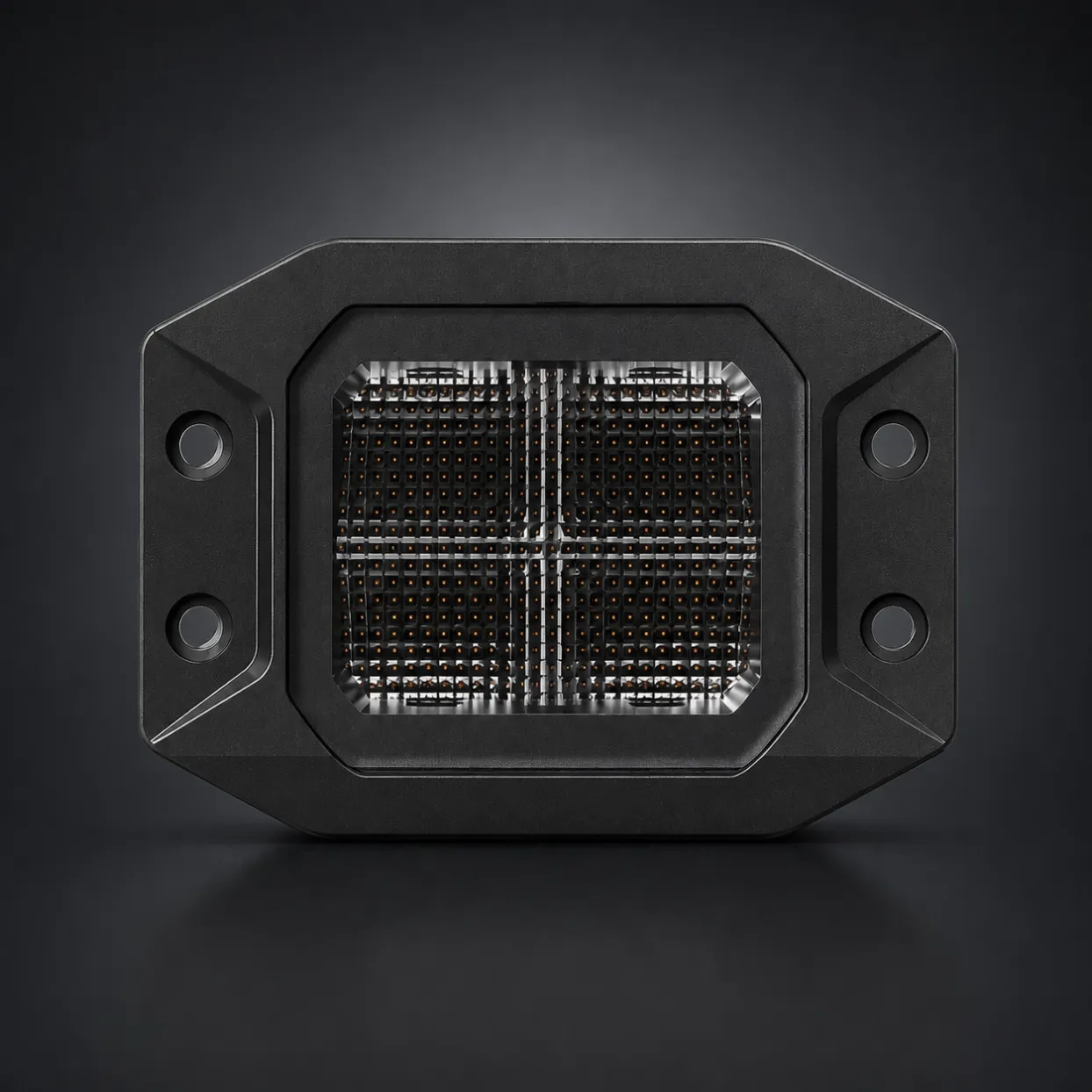
When Should an OEM Choose a Recessed LED Flood Work Light?
A recessed work light can give a truck body, service compartment or machine panel a protected, low-profile appearance. It can also create expensive rework if the panel cutout, cable path or sealing method is approved too late.
The 815B illustrates the key decisions. It is a 24W recessed-mount LED flood work light with 2400 lm brochure-rated output, 10–48V DC input, OSRAM LEDs, 5300–5700K color temperature, aluminum housing, PC lens and a four-hole mounting flange. Its listed dimensions are 140.3 × 70 × 100.3 mm. This website uses IP67 as the maximum protection rating. The brochure lists R10 and a service-life reference of up to 60,000 hours; verify the actual document and model scope.
The Main Buyer Question: Is the Panel Ready for a Recessed Lamp?
A recessed lamp is not a simple surface accessory. The body extends behind the visible flange, so the buyer must confirm internal depth, cable clearance, panel thickness, fastener access and nearby components.
The business value of a recessed design is a cleaner installed profile and reduced exposure to external impact. The purchasing risk is that a wrong cutout affects the vehicle panel, not only the lamp. Request a controlled drawing before tooling, punching or cutting production parts.
Pain Point 1: Cutout Rework Can Cost More Than the Lamp
A few millimeters of mismatch can create loose fitment, visible gaps or interference behind the panel. The 815B body measures 140.3 × 70 × 100.3 mm, with brochure tolerance of ±1 mm, but the final cutout and mounting-hole pattern must come from the approved drawing.
Build a production-intent panel sample before volume approval. Check insertion, fastener access, cable bend radius and removal for service. This can prevent scrapped panels, line stoppage and manual correction.
Pain Point 2: Flush Installation Can Hide Heat and Cable Problems
Recessing the housing changes the airflow around the lamp. An OEM should run a continuous-operation test in the real panel cavity rather than assume open-air performance.
Measure temperature and current after stabilization, then complete a hot restart. Confirm that the cable is not trapped against a sharp edge and that service technicians can disconnect the lamp.
The commercial benefit is lower field failure risk and a more predictable replacement procedure.
Pain Point 3: Wide Beam Coverage Depends on Mounting Position
The 815B flood beam is intended for wide-area illumination. A fixed recessed position may offer less aiming flexibility than an external bracket, so the panel angle becomes part of the optical specification.
Test the beam from the actual body position. Evaluate shadows caused by steps, doors, bumpers and machine structures. A correctly located recessed flood light can improve nearby coverage without projecting hardware outside the body.
Pain Point 4: Sealing Is a System, Not a Label
The website lists IP67 for the series. Buyers should request supporting evidence, but the installed result also depends on the panel interface, fasteners, cable entry and connector.
Define gasket or sealant requirements, fastener torque and drainage around the cavity. Inspect the sample after water and vibration testing. This turns a rating into an installation process that can be repeated in production.
Pain Point 5: Multi-Voltage Simplification Requires Harness Control
The specified 10–48V DC range supports common 12V, 24V, 36V and 48V systems. For an OEM with several platforms, that can reduce lamp variants.
Still, the harness must be specified. Confirm current at the target voltage, connector, polarity, fuse, wire gauge and cable length. A wide-voltage product reduces inventory only when the electrical interface stays consistent.
Pain Point 6: Document Scope Must Be Verified
The brochure lists R10. Request the document and confirm that the 815B model and production marking are within scope. Local use and installation rules remain the responsibility of the destination market.
Document control reduces the risk of approving a lamp that cannot support the expected catalog or tender statement.
Who Benefits From a Recessed Flood Work Light?
Service-body and utility-truck manufacturers may want a protected, integrated lamp.
Trailer and equipment OEMs may use recessed flood lighting around loading or service areas.
Emergency and maintenance fleets may value reduced protrusion and easier exterior cleaning.
Distributors may serve replacement markets where the cutout and hole pattern are known.
Private-label brands need stable drawings and production consistency to avoid fitment complaints.
OEM Approval Checklist
- Obtain the final drawing, cutout and hole pattern.
- Confirm internal depth and cable clearance.
- Build a production-intent panel sample.
- Test the flood beam at the fixed panel angle.
- Measure current and temperature in the enclosed installation.
- Check cable protection and service removal.
- Validate the IP67 installation interface.
- Review the R10 document and model scope.
- Freeze the panel drawing, lamp sample, fastener process and packaging.
Frequently Asked Questions
Why choose recessed instead of surface mount?
Recessed mounting can reduce protrusion and integrate the lamp into the body. It requires more panel engineering and offers less after-installation aiming flexibility.
Does the 10–48V range eliminate electrical checks?
No. Current, fuse, wire gauge, connector and polarity must still be confirmed for the target voltage.
Can the 2400 lm figure predict the real work area?
No. The brochure-rated output is a starting point. Beam distribution, panel angle and vehicle obstructions determine useful illumination.
What should an OEM include in an RFQ?
Include panel drawing, cutout limits, internal depth, voltage, annual quantity, destination market, connector, cable, sealing method, documents, branding and packaging.
Final Purchasing Perspective
A recessed LED flood work light creates value when optical coverage and body integration are engineered together. The best purchasing decision is not the lowest unit price; it is the configuration that fits the panel, seals consistently, supports the harness and can be serviced without rework.